
Generators
How to choose the right generator for camping, caravans, tiny homes and off-grid backup power.
Why a Generator Still Has a Place Off-Grid
Solar and battery systems handle most off-grid power needs, but a generator fills the gaps — extended cloudy weather, high-draw appliances, rapid battery recharging and remote locations where solar alone isn't enough.
Choosing the right generator means matching output to your actual loads, understanding the trade-offs between inverter and conventional models, and knowing how to integrate it safely with your battery system.
Affiliate disclosure: We may earn a commission if you purchase through our links, at no extra cost to you.
Inverter vs Conventional Generators
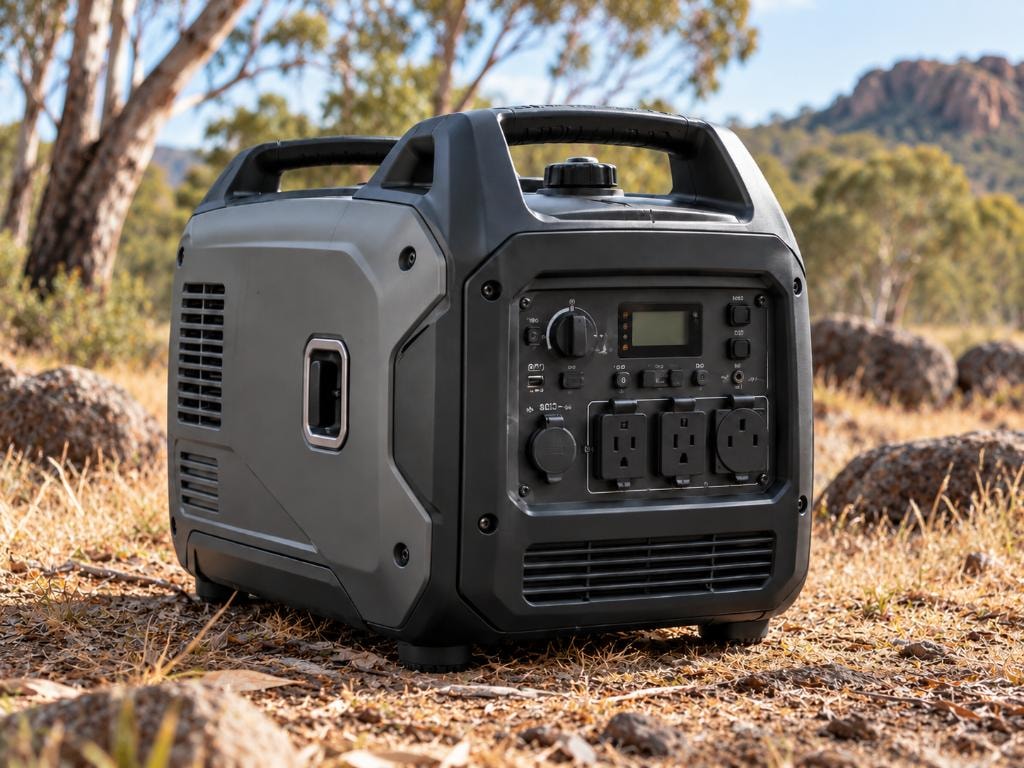
Inverter generators produce clean, stable power (low total harmonic distortion) by converting AC to DC and back to AC through a microprocessor. This makes them safe for sensitive electronics — laptops, CPAP machines, phone chargers and modern appliances. They are quieter, more fuel-efficient at partial load and more compact than conventional models.
Conventional generators produce raw AC power directly from the alternator. They are cheaper to buy, simpler to maintain and available in much higher output ratings. The trade-off is higher noise, less fuel efficiency at partial load and power quality that can damage sensitive electronics without a power conditioner.
For camping, caravanning and powering electronics, an inverter generator is almost always the better choice. Conventional generators make more sense for heavy-duty site work, running power tools or as a primary backup for a large off-grid property.
Output in Watts & kVA — How Much Do You Need?
Generator output may be rated in watts (W), kilowatts (kW), volt-amperes (VA) or kilovolt-amperes (kVA). Watts measure real usable power, while VA/kVA represent apparent power. The relationship depends on the power factor of the connected load, so 1 kVA does not always equal a fixed number of watts.
For practical generator selection, use the manufacturer's rated continuous wattage wherever possible. Add up the running wattage of the appliances you expect to operate at the same time, then allow additional capacity for starting surges from motors and compressors.
As a broad guide, around 1,000–2,000W may suit basic camping loads, 2,000–3,500W may suit larger caravan loads and battery charging, and higher-output generators may be required for air conditioners, workshops or larger off-grid systems. Always check the actual appliance wattage and generator specifications before buying.
Starting Surge — Why It Matters
Any appliance with an electric motor — air conditioners, compressor fridges, water pumps, power tools — draws a surge of current when it starts, typically 3–5 times its running wattage. A generator must handle this surge without stalling or tripping.
Always check the starting (peak) wattage of your highest-draw motor appliance and ensure the generator's maximum output exceeds it. A 2,400W rated inverter generator with a 2,800W peak can typically start a small air conditioner, but check the specific model's surge rating before buying.
Fuel Use & Runtime
Fuel consumption is usually quoted at 25%, 50% and 75% load. Inverter generators are significantly more efficient at partial load — a 2,000W inverter generator running at 50% load might use 0.6–0.9 litres per hour, compared to 1.2–1.5 litres for a conventional model of similar rating.
Runtime on a full tank varies from 4–6 hours for a compact camping model to 8–12 hours for a larger unit. For extended off-grid use, consider how much fuel you can carry and whether LPG or dual-fuel models are practical for your setup.
Noise Levels
Generator noise is measured in decibels (dB) at a set distance — typically 7 metres. Inverter generators typically run at 50–65 dB, roughly equivalent to a normal conversation or a quiet dishwasher. Conventional generators are louder, often 70–80 dB at the same distance.
Many campgrounds and caravan parks have quiet hours and noise restrictions. Check the generator's dB rating before buying if you plan to use it in shared spaces. Some parks ban generators entirely — always check the rules before you arrive.
Portability & Weight
Compact inverter generators in the 1,000–2,000W range typically weigh 10–20kg and have a carry handle, making them manageable for one person. Larger 3,000–5,000W models often weigh 40–70kg and require a wheel kit or two people to move.
For camping and 4WD touring, weight and size matter as much as output. A 13kg 2,000W inverter generator that fits in the back of a ute is far more practical than a 35kg unit that takes up half your cargo space.
Using a Generator to Recharge Battery Systems
One of the most practical uses for a generator off-grid is recharging a lithium or AGM battery bank during extended cloudy weather or high-consumption periods. Connect the generator to a quality AC battery charger or inverter-charger to top up your batteries efficiently.
Match the battery charger to both the generator's continuous output and the battery manufacturer's recommended charge rate. For example, a 2,000W generator may comfortably operate a charger drawing around 1,000–1,500W, allowing some headroom for charger losses and other loads. Actual recharge time depends on battery capacity, state of charge, charger output, battery voltage and charge limits.
Some off-grid inverter-charger systems can be configured for automatic generator start and stop based on battery state of charge or system load. This usually requires compatible control equipment, relays or an energy-management device, so check the manufacturer's requirements before designing the system.
Choosing by Use Case
Weekend camping: A 1,000–1,600W inverter generator is quiet, light and handles all typical camping loads — phone charging, LED lighting, a small fan and a portable fridge charger.
Caravan or camper trailer: A 2,000–2,400W inverter generator handles air conditioning, battery charging and general appliance use. Look for parallel capability so you can run two units together for higher loads.
Tiny home or off-grid cabin: A 3,500–5,000W inverter or conventional generator provides backup power for the whole system, including battery charging, water pumps and high-draw appliances.
Emergency home backup: A 5,000W+ conventional generator can run essential circuits — fridge, lighting, a few power points — during a grid outage. Pair with a transfer switch for safe connection to your home's switchboard.
Affiliate disclosure: We may earn a commission if you purchase through our links, at no extra cost to you.