
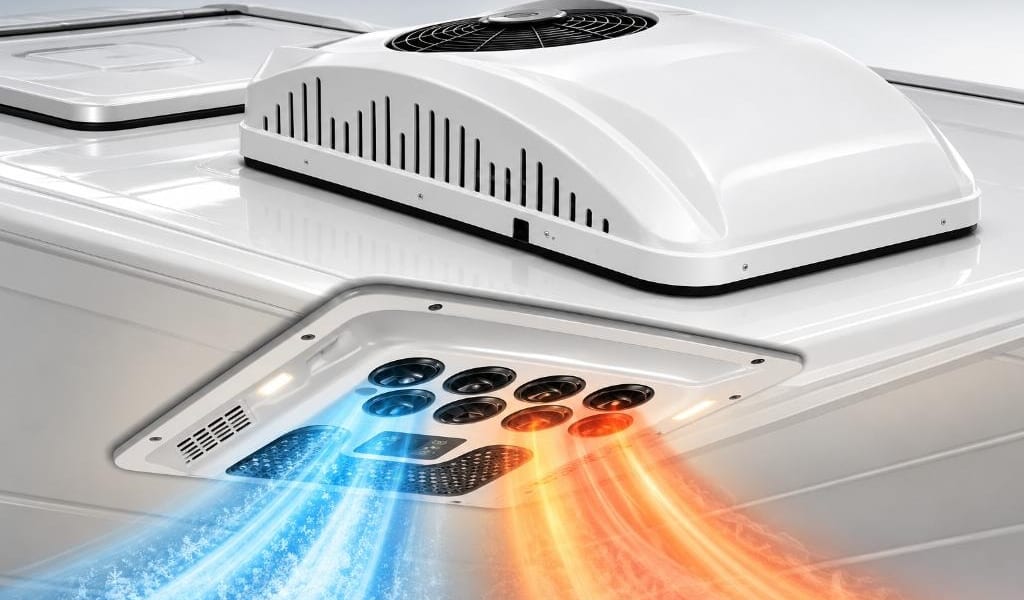
12V Air Conditioners
How to choose a 12V air conditioner for caravans, 4WDs, tiny homes and off-grid use — including power, cooling capacity and installation.
Staying Cool Off-Grid Without Shore Power
A 12V air conditioner runs directly from your battery bank, making it possible to cool a caravan, camper or tiny home without a generator or mains power. Advances in compressor technology have brought power consumption down significantly, making 12V cooling a practical option for well-equipped off-grid setups.
The trade-off is that air conditioning is one of the highest-draw appliances you can run off-grid. Getting the battery capacity and solar input right before you buy is essential — an undersized system will leave you hot and flat.
Affiliate disclosure: We may earn a commission if you purchase through our links, at no extra cost to you.
Power Consumption — The Critical Number
Modern 12V air conditioners typically draw significant current at 12V when running, depending on the ambient temperature and the cooling load — check the manufacturer's rated input power. Some variable-speed units draw less at lower settings, which significantly extends battery runtime.
At 40A average draw, a 200Ah lithium battery (160Ah usable at 80% DoD) will run a 12V air conditioner for roughly 4 hours before the battery needs recharging. For overnight cooling, you need either a very large battery bank or a combination of solar and battery.
Always check the manufacturer's amp draw figures at your expected operating temperature — a unit rated at 30A at 25°C ambient may draw 50A+ on a 40°C Australian summer day.
Battery Capacity Requirements
For practical overnight cooling, battery sizing should be based on your air conditioner's actual input power, expected runtime, other loads and usable battery capacity. As a worked example, a unit drawing 40A average would need significant battery capacity for overnight use — calculate from your specific unit's draw.
Lithium (LiFePO4) batteries are strongly preferred for air conditioning loads. Their ability to deliver high continuous current without voltage sag, combined with 80–100% usable capacity, makes them far more suitable than AGM lead-acid batteries for this application.
Some 12V air conditioner systems are designed to run at 24V or 48V for improved efficiency. If you are building a new system from scratch, a 24V or 48V battery bank with a DC-DC converter or native 24V/48V unit can reduce cable losses and improve overall efficiency.
Solar Requirements
To run a 12V air conditioner during the day and recharge your batteries for overnight use, solar sizing should be based on your air conditioner's actual consumption, other loads, charging losses and available solar production. Calculate from your specific situation rather than applying a universal panel wattage.
Solar alone is rarely enough to run air conditioning continuously — the sun goes down, clouds roll in and panels lose efficiency in extreme heat. Think of solar as reducing your battery drain rather than eliminating it. A generator or shore power connection for top-up charging is a practical backup for extended hot weather.
Use an MPPT charge controller sized for your panel array. Calculate controller requirements from your array voltage and current, and match to the controller's specifications — do not apply a universal amperage rule.
Cooling Capacity — BTU and kW
Cooling capacity is measured in BTU (British Thermal Units) per hour or kilowatts (kW). 1 kW of cooling ≈ 3,412 BTU/hr. Most 12V caravan air conditioners fall in the 2,000–3,500W (7,000–12,000 BTU) range.
As a rough guide: a small caravan or camper van (under 5m) needs around 2,000–2,500W of cooling. A mid-size caravan (5–7m) needs 2,500–3,500W. Larger caravans or tiny homes may need 3,500W+ or multiple units.
Insulation quality, window area, roof colour and the number of occupants all affect how hard the air conditioner has to work. A well-insulated caravan with reflective window covers needs significantly less cooling capacity than a poorly insulated one in direct sun.
Rooftop vs Split System Units
Rooftop units are the most common choice for caravans. They mount through the roof, combining the compressor, condenser and evaporator in a single unit. Installation is straightforward and they don't take up interior space. The trade-off is added roof weight and height.
Split system units separate the compressor (mounted externally, often under the caravan or in a storage bay) from the indoor evaporator head. They are quieter inside, can be more efficient and don't add roof height — useful for low-clearance garages or tight campsites. Installation is more complex.
Some 12V units are designed as portable units that sit inside the space and vent through a window or wall. These are easier to install and move between vehicles but are generally less efficient and noisier than fixed rooftop or split systems.
Installation Considerations
Cable sizing is critical for 12V air conditioning. At 40A draw over a 3–4 metre cable run, you need heavy-gauge cable (typically 6–10mm²) to minimise voltage drop. Voltage drop reduces efficiency and can cause the unit to cut out under load.
A dedicated circuit breaker or fuse rated for the unit's maximum draw is essential. Cable sizing and protection must follow the maximum current, total circuit length, voltage-drop requirements and the manufacturer's instructions for your specific unit.
Roof penetrations must be properly sealed to prevent water ingress. Most rooftop units include a roof seal kit, but the quality varies — inspect the seal carefully and apply additional sealant if needed.
If you are not confident with 12V electrical work, have the installation done by a qualified auto electrician or caravan service centre. A poorly wired high-current circuit is a fire risk.
Choosing by Use Case
Caravan or camper trailer: A rooftop 12V unit in the 2,500–3,500W range with 400–600Ah of lithium storage and 600–800W of solar is a practical starting point for Australian summer conditions.
4WD or camper van: Space and weight are at a premium. Look for compact, lightweight units with variable-speed compressors that can run efficiently at lower settings. A 200–300Ah lithium battery with 300–400W of roof-mounted solar handles moderate cooling loads.
Tiny home or off-grid cabin: A fixed split system with a larger battery bank (600Ah+) and 800W+ of solar provides the most comfortable and efficient cooling. Consider a 24V or 48V system for reduced cable losses at higher power levels.
Emergency or occasional use: A portable 12V unit that can be moved between vehicles and powered from a compatible power source is an option for those who only need cooling occasionally — note that many 12V outputs on portable power stations cannot supply enough current for high-draw 12V air conditioners. Check the unit's 12V output current rating against the air conditioner's requirements.
Affiliate disclosure: We may earn a commission if you purchase through our links, at no extra cost to you.