UHF Radios for 4WD & Remote Touring — Australian Buying Guide 2026
A UHF CB radio is one of the most practical communication tools you can carry on a 4WD trip or remote camping adventure. Unlike mobile phones and satellite communicators, UHF CB operates on a shared, licence-free band that lets you talk directly with other vehicles in your convoy, alert nearby campers, and communicate with road trains and other heavy vehicles on outback tracks. This guide covers the practical side of UHF CB for Australian 4WD tourers — what the technology does, what it does not do, how to choose the right radio and antenna, and how to use the Australian CB channel plan correctly. Important: UHF CB is a short-range communication tool. It is not a replacement for a registered 406 MHz PLB, a satellite communicator or any other emergency distress device. Always carry an appropriate emergency device when travelling in remote areas.
Affiliate disclosure: We may earn a commission if you purchase through our links, at no extra cost to you. Learn more.
Why Carry a UHF Radio?
Australian UHF CB generally operates in the 476–477 MHz band and is the standard short-range communication tool for 4WD touring and remote travel in Australia. It is licence-free, requires no subscription, and works without any network infrastructure — making it reliable in areas where mobile coverage is absent.
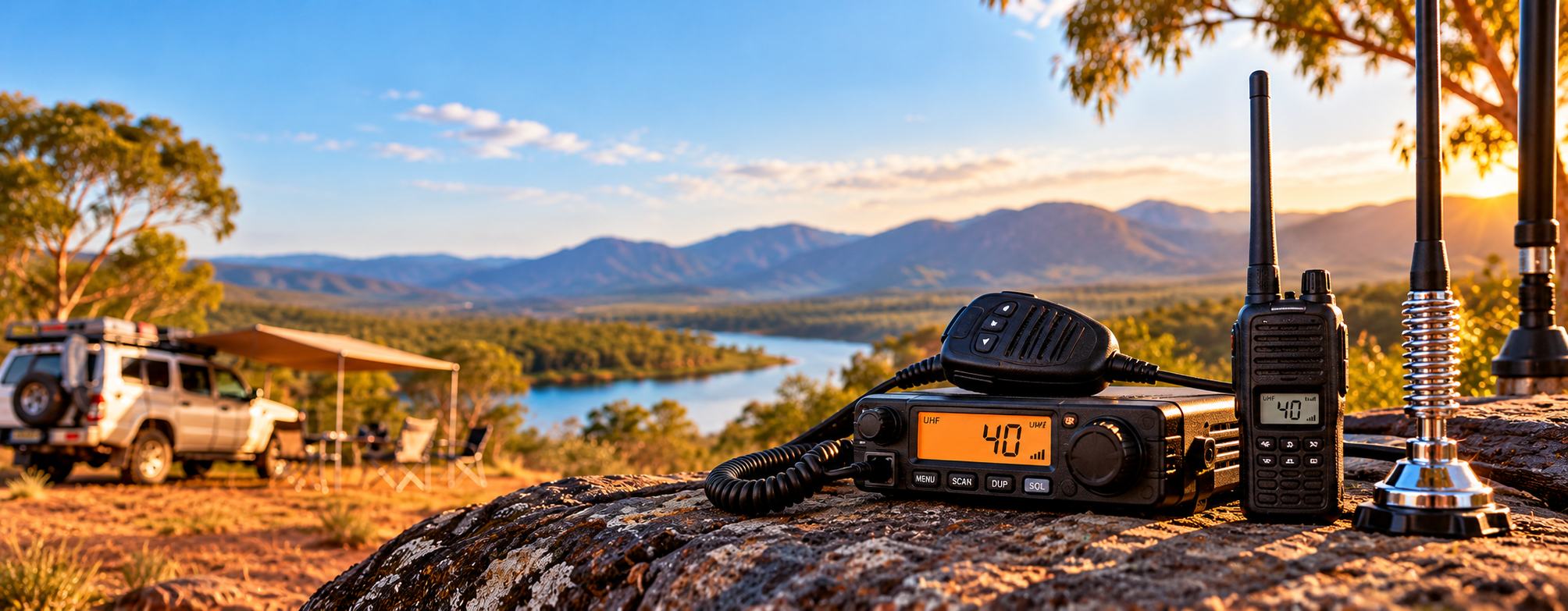
The most common uses for UHF CB on a 4WD trip are convoy communication, where all vehicles in a group can stay in contact on a shared channel; campsite communication, where you can talk to others in your group across a campsite or between nearby camps; and road communication, where you can alert oncoming vehicles to your position on narrow outback tracks, or receive warnings from road trains and other heavy vehicles. Channel 40 is commonly used by road transport and 4WD travellers across Australia.
UHF CB is also useful for communicating with nearby campers in an emergency — for example, alerting a neighbouring camp that you need assistance. However, UHF CB range is limited by terrain, antenna height and transmitter power. In open flat country, a vehicle-mounted radio with a good antenna may achieve useful range across several kilometres. In hilly or heavily vegetated country, range may be considerably less. Do not rely on UHF CB as your sole emergency communication method in remote areas. A registered 406 MHz PLB or satellite communicator is essential for genuine emergency distress alerting.
Handheld vs Vehicle-Mounted UHF Radios
Australian UHF CB radios are available in two main form factors: handheld portable units and vehicle-mounted units. Each has practical advantages depending on how you tour.
Handheld UHF radios are battery-powered, compact and portable. They can be used outside the vehicle, carried on foot around a campsite, or used as a backup if your vehicle-mounted radio fails. The main limitation of handheld radios is antenna efficiency — the short stub antenna on a handheld is less efficient than a full-size roof-mounted antenna, which reduces practical range. Handheld batteries also require regular charging or replacement. Handhelds are a good choice for campers who want flexibility, or as a secondary radio to complement a vehicle-mounted unit.
Vehicle-mounted UHF radios draw power from the vehicle and use a roof-mounted or bull-bar-mounted antenna, which is typically taller and more efficient than a handheld antenna. This gives vehicle-mounted radios better practical range in most conditions. Compact DIN-sized units fit into a standard head unit slot; smaller remote-head units allow the display and controls to be mounted separately from the radio body, which is useful in vehicles with limited dash space. Vehicle-mounted radios are the preferred choice for serious 4WD tourers who rely on radio communication as a regular part of their touring setup.
Australian UHF CB Channels
Modern Australian UHF CB radios provide 80 channels on the 477 MHz band, as regulated by the Australian Communications and Media Authority (ACMA). The channel plan includes standard simplex channels, duplex repeater channels, and channels reserved for specific uses.
Channel 40 is the channel commonly used by road transport and 4WD travellers, used by road trains, trucks and 4WD tourers for road communication on outback highways and tracks. If you are travelling on remote roads, monitor Channel 40 and announce your position when approaching blind corners or one-lane sections.
Channel 5 and Channel 35 are emergency channels designated for emergency and distress calls. Note that emergency services do not continuously monitor UHF CB emergency channels — do not rely on these channels as a substitute for a PLB or satellite communicator in a life-threatening emergency. They are useful for alerting nearby vehicles or campers who may be monitoring the channel.
Repeater output channels are 1–8 and 41–48; the corresponding repeater input channels are 31–38 and 71–78. Channels 22 and 23 have telemetry and data restrictions for telemetry and data use and must not be used for voice communication. Always follow current ACMA CB radio rules — channel allocations and usage rules are set by ACMA and may be updated. Check the current ACMA CB radio guidelines for the authoritative channel plan before relying on any third-party summary.
Antenna Choice and Practical Range
The antenna is one of the most important factors affecting the practical range of a UHF CB radio. All Australian UHF CB radios are limited to 5 watts of transmitter power by regulation, so antenna choice and mounting position have a significant effect on real-world performance.
Antenna gain is measured in dBi (decibels relative to an isotropic radiator). A higher-gain antenna concentrates the radio signal into a flatter, more horizontal pattern — useful on flat terrain where you want to maximise range to other vehicles at a similar height. Common gain ratings for 4WD UHF antennas are 3 dBi (low gain, wider vertical pattern), 6.5 dBi (medium gain, commonly used for general touring) and 9 dBi (high gain, very flat pattern).
Higher gain is not automatically better. In hilly or mountainous country, a high-gain antenna with a very flat radiation pattern may actually perform worse than a lower-gain antenna, because the signal is directed horizontally and misses vehicles or repeaters that are above or below your position. For general 4WD touring across varied terrain, a 6.5 dBi antenna is a practical all-round choice. A 3 dBi antenna is better suited to very hilly country or when communicating with elevated repeaters.
Antenna height matters. Mounting the antenna as high as possible on the vehicle — typically on the roof, a roof rack, or a bull bar — improves line-of-sight range. Ensure the antenna is mounted with a good ground plane (a metal surface) for best performance where the antenna design requires one — ground-independent designs also exist. Magnetic-mount antennas are convenient but may not perform as well as permanently mounted antennas with a proper ground connection.
Repeater Use
UHF CB repeaters receive a signal on one channel and simultaneously retransmit it on another channel at higher power and from an elevated location — typically a hilltop or tower. This can significantly extend the communication range in areas where a suitable repeater is installed and operational.
To use a repeater, your radio must support duplex operation (transmitting on one channel while receiving on another). Most modern vehicle-mounted UHF CB radios support duplex/repeater mode. Handheld radios vary — check the specifications before purchasing if repeater use is important to you.
Repeater coverage varies significantly by location. In some parts of regional and remote Australia, UHF CB repeaters provide useful extended coverage. In other areas, no repeater infrastructure exists. Do not assume repeater coverage will be available in a specific remote area — check with local 4WD clubs or touring groups for current repeater information in the areas you plan to travel. Repeaters are also subject to maintenance and may be offline at any time.
Choosing a UHF Radio for 4WD Touring
When choosing a UHF CB radio for 4WD touring, the most important decision is whether you need a handheld, a compact vehicle-mounted unit, or a full-size vehicle-mounted unit. For serious remote touring, a vehicle-mounted radio with a quality roof-mounted antenna is the most reliable setup.
Key features to consider include: display clarity and ease of use while driving; microphone controls that allow channel changes and scanning without touching the main unit; scanning capability to monitor multiple channels; duplex/repeater capability if you plan to use repeater infrastructure; dust and water resistance ratings, particularly for vehicles that travel in dusty outback conditions; and the antenna connector type (PL-259/SO-239 is standard on most Australian vehicle-mounted radios).
For installation, a vehicle-mounted radio requires a power connection to the vehicle battery (typically via a fuse), a suitable mounting location for the radio body, and a properly installed antenna with a good ground plane. Many 4WD accessory shops offer professional installation. A poorly installed antenna or a bad ground connection will significantly reduce radio performance regardless of the radio brand or model.
Choose equipment that is sold by reputable Australian dealers and is compliant with Australian CB radio regulations. Avoid uncertified imported radios that may not comply with ACMA power limits or frequency accuracy requirements.
Handheld vs Compact Vehicle-Mounted vs Full-Size Vehicle-Mounted UHF
| Feature | Handheld UHF | Compact Vehicle-Mounted | Full-Size Vehicle-Mounted |
|---|---|---|---|
| Power source | Internal battery | Vehicle 12V | Vehicle 12V |
| Transmitter power | 5W (AU limit) | 5W (AU limit) | 5W (AU limit) |
| Antenna | Short stub or built-in | External roof/bar mount | External roof/bar mount |
| Practical range | Shorter (antenna limitation) | Good | Good to excellent |
| Portability | Fully portable | Vehicle only | Vehicle only |
| Duplex/repeater | Varies by model | Most models | Most models |
| Installation required | No | Yes (power + antenna) | Yes (power + antenna) |
| Best for | Campsite, backup, hiking | Touring, limited dash space | Primary touring radio |
Affiliate Disclosure: Country Heart Outdoors participates in affiliate programs. If you purchase through our links, we may earn a commission at no extra cost to you. This helps support our free buying guides.