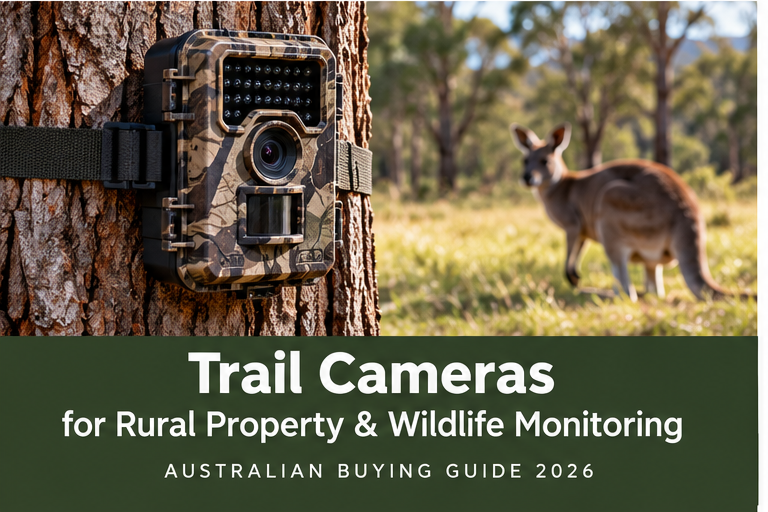
Trail Cameras for Rural Property & Wildlife Monitoring — Australian Buying Guide 2026
Trail cameras — also called camera traps or wildlife cameras — are motion-activated cameras designed to capture images or video when an animal or person passes through the detection zone. They are widely used for wildlife monitoring, property security, feral animal management and simply observing native wildlife on rural land. Modern trail cameras range from basic SD-card models to solar-assisted cellular cameras that send images directly to a phone app. The right choice depends on your intended use, the location, available power, mobile coverage and budget. This guide covers the key factors to consider when choosing a trail camera for Australian rural property and wildlife monitoring use.
Affiliate disclosure: We may earn a commission if you purchase through our links, at no extra cost to you. Learn more.
How Trail Cameras Work
Trail cameras use a passive infrared (PIR) motion sensor to detect movement and heat. When an animal or person enters the detection zone, the camera triggers and captures an image or video. Most cameras have a configurable trigger delay — the minimum time between consecutive triggers — which affects how many images are captured of the same subject. A shorter trigger delay captures more images but uses more battery and storage.
Image and Video Resolution
Trail camera resolution is quoted in megapixels (MP) for images and in standard video resolutions (720p, 1080p, 4K) for video. Higher resolution produces larger files and uses more storage. For most wildlife monitoring and property security purposes, 12–20MP images and 1080p video provide adequate detail. Very high resolution claims (30MP+) on budget cameras are often achieved through interpolation rather than true sensor resolution — actual image quality may not match the quoted figure.
Night Vision and Infrared Flash
Most trail cameras use infrared (IR) LEDs for night photography. There are two main types: standard IR (produces a faint red glow visible to humans and some animals) and no-glow IR (invisible to humans and less likely to disturb wildlife or alert intruders). No-glow cameras are generally preferred for wildlife monitoring and security applications. Night images are typically black and white. Some cameras include a white flash for colour night images, but this is more visible and may disturb wildlife.
Trigger Speed and Detection Range
Trigger speed is the time between the PIR sensor detecting movement and the camera capturing an image. Faster trigger speeds (0.1–0.3 seconds) are better for capturing fast-moving animals. Slower trigger speeds (0.5–1 second or more) may miss fast subjects or capture only the tail end of an animal passing through frame. Detection range is the maximum distance at which the PIR sensor reliably triggers — typically 15–30 metres for most models, though actual performance varies with temperature, vegetation and animal size.
Battery Life
Trail cameras are typically powered by AA batteries — commonly 8 or 12 cells. Battery life varies significantly depending on trigger frequency, temperature, flash type and camera model. In a low-traffic location, a set of quality alkaline or lithium batteries may last several months. In a high-traffic location or cold conditions, battery life will be shorter. Lithium AA batteries perform better than alkaline in cold conditions and have a longer shelf life. Rechargeable NiMH batteries can be used but typically have lower capacity than alkaline or lithium.
Solar-Powered Models
Solar-assisted trail cameras include a small solar panel that trickle-charges an internal battery, extending runtime significantly in locations with adequate sunlight. They are well suited to remote locations where battery replacement is inconvenient. Solar panels on trail cameras are typically small and are designed to supplement rather than fully replace battery power — a backup battery is still required. Placement should consider both the camera's field of view and the solar panel's sun exposure.
SD Card Storage
Trail cameras store images and video on a standard SD card. Most cameras accept cards up to 32GB or 64GB, though some support larger capacities. A 32GB card stores thousands of images at typical trail camera resolutions. Check the maximum supported card size before purchasing a high-capacity card. Use a Class 10 or UHS-I rated card for reliable performance with video recording.
Standard SD-Card, Wi-Fi and Cellular Models
Standard SD-card cameras store images locally and require physical retrieval of the card or the camera to view images. This is the simplest and most affordable option and works in any location regardless of mobile coverage.
Wi-Fi trail cameras can connect to a phone or tablet within Wi-Fi range, allowing image viewing without removing the SD card. Wi-Fi range is typically limited to 10–20 metres, so the phone must be close to the camera.
Cellular (4G) trail cameras send images directly to a phone app via the mobile network. This allows remote monitoring from anywhere with mobile coverage. Cellular cameras require a SIM card and a data plan, and depend on mobile network coverage at the camera location. Mobile coverage varies significantly across rural Australia — check coverage maps for your specific location before purchasing a cellular model. Do not assume coverage will be available at a remote property or bush location.
Weather Resistance
Trail cameras are designed for outdoor use and are typically rated to IP54 or IP65 for weather resistance. Check the IP rating and ensure the camera is suitable for the conditions at your intended location — including rain, humidity, dust and temperature extremes. Australian conditions can be demanding, particularly in tropical and arid regions.
Mounting and Camouflage
Most trail cameras mount to a tree or post using an adjustable strap. Camera height and angle affect detection performance — a height of 60–90cm above the ground and angled slightly downward is a common starting point for ground-level wildlife. Camouflage housing helps the camera blend into the environment and reduces the chance of theft or disturbance. Some cameras include a security cable attachment point for locking to a tree or post.
Privacy Considerations
Trail cameras used on private property for wildlife monitoring and security are subject to applicable Australian privacy laws and regulations. Cameras should not be positioned to capture images of neighbouring properties, public areas or people without appropriate consent. If you are unsure about the legal requirements for your intended use, seek appropriate advice.
Trail Camera Types Compared
| Type | Image Retrieval | Remote Access | Best For |
|---|---|---|---|
| Standard SD-card | Physical card retrieval | No | Any location, simple use |
| Wi-Fi | Phone within range | Limited range | Accessible locations |
| Cellular / 4G | Phone app anywhere | Yes (needs coverage) | Remote monitoring |
| Solar-assisted | Depends on base type | Depends on base type | Remote, low-maintenance |
Affiliate Disclosure: Country Heart Outdoors participates in affiliate programs. If you purchase through our links, we may earn a commission at no extra cost to you. This helps support our free buying guides.