Solar Floodlights & Outdoor Security Lights — Australian Buying Guide 2026
Solar-powered outdoor lighting has become a practical option for Australian properties, particularly in locations where running mains power to a shed, gate or driveway is impractical or expensive. Solar floodlights and security lights range from compact PIR-triggered units to larger multi-light systems with separate solar panels and substantial battery storage. This guide covers the main types of solar outdoor lighting, the factors that affect real-world performance and the practical considerations for choosing a system for sheds, gates, driveways, remote properties and off-grid use.
Affiliate disclosure: We may earn a commission if you purchase through our links, at no extra cost to you. Learn more.
How Solar Outdoor Lights Work
Solar outdoor lights use a photovoltaic panel to charge an internal or external battery during daylight hours. The stored energy powers the LED light at night or when triggered by a motion sensor. The solar panel may be integrated into the light housing or connected via a cable, allowing the panel to be positioned separately for better sun exposure. Battery capacity determines how much energy can be stored and how long the light can operate — this varies significantly between models.
PIR Motion Sensing
Most solar security lights include a PIR (passive infrared) motion sensor that triggers the light when it detects movement. Detection range and angle vary between models. Wider detection angles cover more area but may produce more false triggers from vegetation movement, small animals or passing traffic. Sensitivity adjustment allows the sensor to be tuned to reduce unwanted triggers. PIR sensors detect heat signatures, so they are less effective in very hot conditions where ambient temperature approaches body temperature.
Dusk-to-Dawn and Lighting Modes
Many solar lights offer multiple operating modes. Motion-only mode keeps the light off until triggered, conserving battery. Dusk-to-dawn mode keeps the light on at low brightness all night, switching to full brightness when motion is detected. Some models offer a constant-on mode for all-night full brightness, though this draws more battery and may not last the full night depending on battery capacity and season. Selecting the right mode for your use case affects both performance and battery longevity.
Integrated vs Separate Solar Panels
Lights with integrated solar panels are simpler to install but require the light itself to be positioned where it receives adequate direct sunlight. This can be a limitation under eaves, in shaded locations or on south-facing walls. Lights with separate solar panels connected by a cable allow the panel to be positioned in full sun while the light is mounted in the most useful location. Separate-panel systems are generally better suited to locations with limited direct sun at the mounting point.
Battery Capacity and Charging Performance
Battery capacity is measured in milliamp-hours (mAh) or watt-hours (Wh). Higher capacity allows longer operation, but actual runtime depends on brightness setting, how often the light is triggered and the amount of solar energy collected each day. In southern Australia during winter, shorter days and lower sun angles reduce charging performance. In northern Australia, high temperatures can affect battery longevity over time. Avoid blanket claims about runtime — it varies with battery capacity, sunlight hours and operating settings.
Brightness and Beam Spread
Brightness is measured in lumens. For a shed entrance or gate, 400–800 lumens is typically adequate. For a large driveway, yard or security application, 1,000 lumens or more may be appropriate. Beam spread affects how wide an area is illuminated — a narrow beam concentrates light in one direction, while a wide beam covers more area at lower intensity. Consider both brightness and beam spread when assessing whether a light will adequately illuminate the intended area.
Weather Resistance
Outdoor lights should carry an IP (Ingress Protection) rating indicating resistance to dust and water. IP65 is a common rating for outdoor lights, indicating dust-tight and protection against water jets. IP66 and IP67 offer greater water resistance. For exposed coastal or high-rainfall locations, a higher IP rating is preferable. Check that both the light housing and the solar panel are rated for outdoor use.
Mounting Options
Solar floodlights are typically wall-mounted using included brackets. Some models include adjustable mounting brackets that allow the light to be angled for optimal coverage. For fence posts, poles or trees, check whether the mounting hardware suits the intended surface. Height affects both detection range and illumination coverage — mounting too low reduces detection range, while mounting too high may reduce illumination effectiveness at ground level.
Sheds, Gates and Driveways
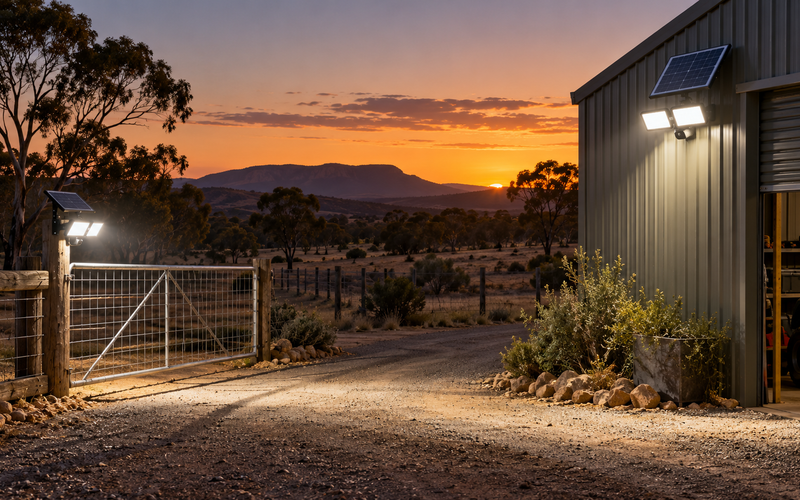
For a shed entrance, a single PIR-triggered solar light positioned above the door provides practical illumination when entering at night. For a gate or driveway, a light with a longer detection range and wider beam spread is more useful. For a long driveway, multiple lights may be needed to provide adequate coverage. Consider whether the light needs to illuminate the full driveway width or just the entry point.
Remote Properties and Off-Grid Use
Solar outdoor lighting is well suited to remote properties where mains power is unavailable. For off-grid use, prioritise models with larger battery capacity and separate solar panels that can be positioned for maximum sun exposure. In areas with extended cloudy periods, a larger panel and battery combination provides more reliable performance. Multi-light systems with a central battery and multiple light heads are available for larger installations.
Multi-Light Systems
Multi-light systems use a single solar panel and battery to power multiple light heads. This approach is more efficient than multiple independent lights and allows a larger solar panel and battery to be used, improving reliability. Multi-light systems are well suited to sheds, yards and larger installations where multiple areas need to be illuminated from a single installation point.
Installation Position
Position solar lights where the panel receives maximum direct sunlight — ideally north-facing in Australia. Avoid locations shaded by trees, eaves or other structures during peak sun hours. For PIR-triggered lights, position the sensor to cover the intended detection zone without pointing directly at the sun or at heat sources that may cause false triggers. Test the detection zone before finalising the mounting position.
Solar Outdoor Light Types Compared
| Type | Best For | Panel | Key Consideration |
|---|---|---|---|
| Integrated PIR floodlight | Shed entrances, gates | Built-in | Needs sun at mounting point |
| Separate-panel floodlight | Shaded locations | Remote cable | More flexible positioning |
| Dusk-to-dawn light | Pathways, yards | Built-in or separate | Higher battery draw |
| Multi-light system | Sheds, larger yards | Central panel | Single installation, multiple heads |
Affiliate Disclosure: Country Heart Outdoors participates in affiliate programs. If you purchase through our links, we may earn a commission at no extra cost to you. This helps support our free buying guides.