Rechargeable Work Lights for Camping, 4WD & Property Use — 2026
A good work light makes a significant difference when working on a vehicle at a remote campsite, setting up camp after dark or carrying out property maintenance. Rechargeable LED work lights have largely replaced corded and disposable-battery work lights for portable use, offering practical brightness and runtime from a USB-C rechargeable battery. This guide covers the main types of rechargeable work lights, the factors that affect real-world performance and the practical considerations for camping, 4WD touring and rural property use.
Affiliate disclosure: We may earn a commission if you purchase through our links, at no extra cost to you. Learn more.
LED Work Light Types
Rechargeable work lights are available in several form factors suited to different tasks. Handheld work lights are compact and portable, suitable for inspection tasks and close work. Magnetic-base lights attach to metal surfaces — vehicle panels, engine bays, roof racks — freeing your hands for the task. Tripod lights provide stable, elevated illumination for larger work areas. Inspection lights are slim and flexible, designed for accessing confined spaces such as engine bays, under-vehicle areas and tight storage compartments.
Magnetic-Base Lights
Magnetic-base work lights are particularly useful for vehicle work. They attach securely to steel panels, bonnets and chassis components, holding the light in position while you work. Magnet strength varies between models — a stronger magnet is more secure on vertical surfaces. Some models include a hook as well as a magnet, providing more mounting options. Check that the magnet is strong enough to hold the light securely on the surfaces you intend to use it on.
Tripod Lights
Tripod work lights provide stable, elevated illumination for larger work areas such as a campsite, workshop or property maintenance task. The tripod allows the light to be positioned at a useful height and angle without requiring a mounting surface. Most tripod lights are collapsible for transport. Look for a stable tripod design that will not tip over on uneven ground. Some models include a telescoping pole for adjustable height.
Inspection Lights
Inspection lights are slim, flexible or articulated lights designed for accessing confined spaces. They are useful for working in engine bays, under vehicles, inside storage compartments and in other areas where a larger light cannot be positioned effectively. Many inspection lights include a magnetic base and a hook for versatile positioning. Some models include a flexible neck that can be bent to direct the beam into a specific area.
Brightness and Beam Spread
Work light brightness is measured in lumens. Higher lumen numbers do not automatically mean a better light — beam spread, colour temperature and the efficiency of the optics all affect how useful the light is in practice. A narrow, focused beam concentrates light in one direction and is useful for inspection tasks. A wide flood beam illuminates a larger area at lower intensity and is more useful for general work lighting. Many work lights offer both spot and flood modes or an adjustable beam.
USB-C Charging and Removable Batteries
USB-C charging is now standard on quality rechargeable work lights, allowing charging from a power bank, vehicle USB adapter or solar panel. Some models use removable battery packs that can be swapped for a charged spare, extending working time without waiting for a recharge. Removable battery systems are particularly useful for extended remote use. Check the charging time and whether the light can be used while charging.
Impact and Weather Resistance
Work lights are used in demanding environments and should be built to withstand drops, dust and moisture. Look for an IP rating — IP65 indicates dust-tight and water jet resistance, suitable for outdoor use in rain. Some models carry an IK rating indicating impact resistance. For vehicle and property work, a robust housing that can withstand being knocked over or dropped is preferable to a lightweight model that may not survive field use.
Workshop Use
For a workshop or shed, a tripod work light provides flexible, portable illumination that can be positioned where needed. A magnetic-base light is useful for close work on metal surfaces. For a fixed workshop installation, a mains-powered LED work light provides consistent illumination without battery management. Rechargeable work lights are most useful in a workshop context as portable supplementary lighting rather than primary fixed lighting.
Vehicle Repairs at Camp
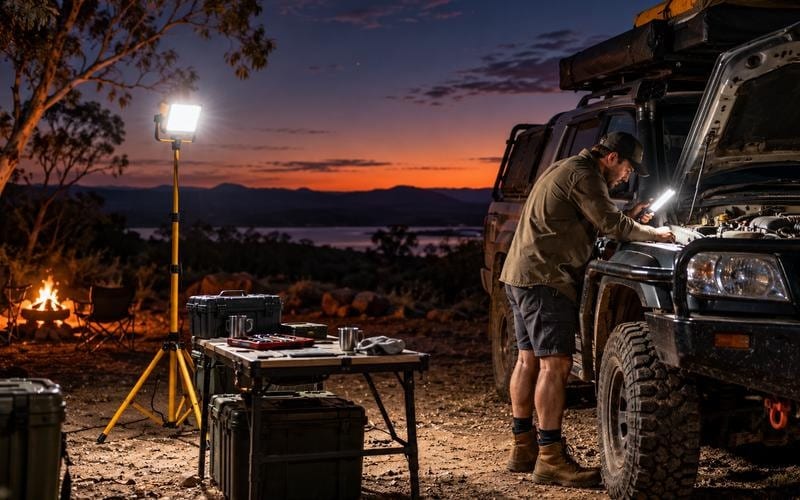
A magnetic-base work light is one of the most useful tools for roadside or campsite vehicle repairs. It attaches to the vehicle body to illuminate the work area, leaving both hands free. An inspection light is useful for diagnosing issues in confined areas. Carry a fully charged work light as part of your vehicle recovery and maintenance kit. A power bank allows the light to be recharged if needed during an extended repair.
Night-Time Campsite Setup
A tripod work light or a high-output rechargeable lantern provides practical illumination for setting up camp after dark. Position the light to illuminate the tent area, camp kitchen or awning space. A magnetic light attached to the vehicle or a roof rack rail can provide useful supplementary lighting. For a large campsite or group camp, multiple lights positioned around the site provide better coverage than a single central light.
Rural Property Work
For rural property maintenance tasks — fencing, irrigation, shed work, equipment repairs — a rechargeable work light provides practical portable illumination. A tripod light is useful for larger outdoor tasks. A magnetic-base light is useful for equipment and vehicle work. For extended property work, a model with a removable battery or a long runtime at working brightness is preferable to a model with high peak brightness but short runtime.
Emergency Roadside Use
A rechargeable work light is a useful addition to a vehicle emergency kit. In a breakdown or roadside emergency, it provides illumination for assessing the situation, carrying out repairs and signalling. A flashing red mode is useful for roadside visibility. Keep the light charged as part of regular vehicle preparation. A model with a long standby time ensures the light is ready when needed after extended periods without use.
Rechargeable Work Light Types Compared
| Type | Best For | Mounting | Key Consideration |
|---|---|---|---|
| Magnetic-base light | Vehicle work | Magnetic to steel | Magnet strength matters |
| Tripod light | Campsite, workshop | Freestanding | Stability on uneven ground |
| Inspection light | Confined spaces | Magnetic or hook | Flexible neck useful |
| Handheld floodlight | General portable use | Hand-held | Balance weight and output |
Affiliate Disclosure: Country Heart Outdoors participates in affiliate programs. If you purchase through our links, we may earn a commission at no extra cost to you. This helps support our free buying guides.