Perimeter Warning Systems & Driveway Alerts — Australian Buying Guide 2026
Knowing when a vehicle, person or animal has entered your property, driveway or campsite can be useful for security, convenience and safety. Perimeter warning systems range from simple driveway chimes to multi-zone wireless sensor networks with phone alerts. This guide covers the main types of perimeter warning and driveway alert systems available in Australia, their practical differences and the factors to consider when choosing a system for a rural property, shed, gate or campsite. The focus is on lawful property notification systems — not covert surveillance or invasive monitoring.
Affiliate disclosure: We may earn a commission if you purchase through our links, at no extra cost to you. Learn more.
Simple Driveway Chimes
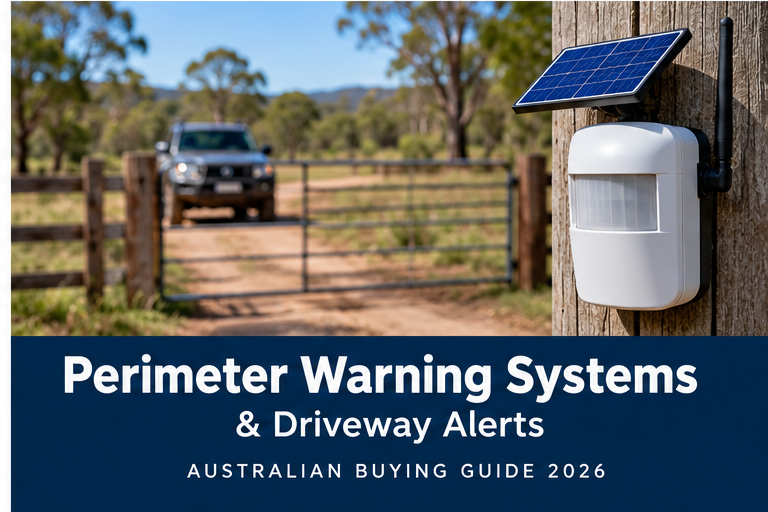
A basic driveway chime system consists of a PIR (passive infrared) motion sensor and a wireless receiver with a chime or alert tone. When the sensor detects movement, it sends a wireless signal to the receiver, which sounds an alert. These systems are simple, affordable and easy to install. They are well suited to driveways, gates, shed entrances and campsites where you want a basic notification that someone or something has entered the detection zone. Range between sensor and receiver is typically 100–300 metres for most consumer-grade systems, though walls, vegetation and terrain can reduce effective range.
PIR Motion Sensors
PIR sensors detect the infrared heat signature of moving objects — people, vehicles and large animals. Detection range and angle vary between models. Wider detection angles cover more area but may produce more false triggers from vegetation movement or small animals. Narrower angles are more directional and can be aimed at a specific entry point such as a gate or driveway. Sensitivity adjustment allows the sensor to be tuned to reduce false triggers from small animals or wind-blown vegetation.
Beam Sensors
Beam sensors (also called photoelectric or infrared beam sensors) use a transmitter and receiver positioned opposite each other. When an object breaks the beam, an alert is triggered. Beam sensors are more reliable than PIR sensors in environments with variable temperatures or where PIR false triggers are a problem. They are well suited to driveways, gates and defined entry points where the beam can be reliably aligned. Beam sensors require more precise installation than PIR sensors.
Wireless Perimeter Sensor Systems
Multi-zone wireless systems allow multiple sensors to connect to a single receiver or control panel. Each sensor can be assigned to a different zone — for example, front gate, shed entrance, back paddock gate and campsite perimeter. The receiver displays which zone triggered and may sound different alerts for different zones. These systems are well suited to larger rural properties where monitoring multiple entry points from a central location is useful.
App-Connected and Phone Alert Systems
Some perimeter warning systems include Wi-Fi or cellular connectivity that sends push notifications or SMS alerts to a phone when a sensor triggers. These systems allow remote monitoring when you are away from the property. Wi-Fi-connected systems require a Wi-Fi network at the property. Cellular systems require mobile coverage. As with cellular trail cameras, mobile coverage varies across rural Australia — check coverage at your specific location before purchasing a cellular-connected system.
Camera-Based Systems
Camera-based perimeter systems combine motion detection with video capture, allowing you to see what triggered the alert. These range from simple Wi-Fi cameras with motion alerts to more sophisticated systems with local recording, cloud storage and remote viewing. Camera-based systems provide more information than sensor-only systems but are more complex to install and configure, require power and connectivity, and involve additional privacy considerations regarding image capture and storage.
Solar and Battery Power
Many perimeter sensors are battery-powered, making them easy to install without wiring. Battery life depends on trigger frequency and battery capacity — in a high-traffic location, batteries may need replacing every few months. Solar-powered sensors include a small panel that extends battery life, making them well suited to remote locations. Ensure the solar panel has adequate sun exposure at the installation location.
Sirens and Chimes
Receivers are available with a range of alert options — chimes, sirens, voice announcements and silent alerts (LED flash only). For a home or shed, a chime or voice alert is usually sufficient. For a campsite or remote location where you may be sleeping, a louder siren or vibrating alert may be more useful. Some systems allow different alert tones for different sensor zones.
Rural Sheds, Gates and Driveways
For a rural shed or workshop, a simple PIR sensor and chime receiver provides a basic notification when someone enters. For a driveway or gate, a beam sensor or long-range PIR sensor positioned at the entry point gives reliable detection of vehicles and pedestrians. For a property with multiple entry points, a multi-zone wireless system allows monitoring of all entry points from a single receiver.
Campsite Use
A portable PIR sensor and wireless receiver can be useful at a campsite to alert you to approaching animals or people. Compact battery-powered systems are available that can be set up quickly and packed away easily. Sensitivity should be adjusted to reduce false triggers from small animals and wind. Position sensors to cover the most likely approach routes to the campsite.
Privacy and Legal Considerations
Perimeter warning systems used on private property for security and notification purposes are subject to applicable Australian laws and regulations. Systems should not be used for covert surveillance, monitoring of public areas or capturing images of people without appropriate consent. Focus on lawful property security and notification. If you are unsure about the legal requirements for your intended use, seek appropriate advice.
Perimeter Warning System Types Compared
| System Type | Detection Method | Alert Method | Best For |
|---|---|---|---|
| Simple driveway chime | PIR sensor | Chime at receiver | Single entry point, basic alert |
| Beam sensor | Infrared beam break | Chime or siren | Driveways and defined entry points |
| Multi-zone wireless | Multiple PIR or beam sensors | Zone-specific alerts | Larger properties, multiple entries |
| App-connected | PIR or beam | Phone push notification | Remote monitoring (needs coverage) |
| Camera-based | Motion + video | Alert with video | Visual verification of triggers |
Affiliate Disclosure: Country Heart Outdoors participates in affiliate programs. If you purchase through our links, we may earn a commission at no extra cost to you. This helps support our free buying guides.