Off-Grid Outdoor Lighting for Rural Properties — Australian Guide 2026
Lighting a rural property without mains power requires a different approach to urban or suburban lighting. Solar-powered and battery-backed lighting systems have made it practical to illuminate pathways, gates, sheds, driveways and outbuildings on properties where running mains power is impractical or uneconomical. This guide covers the main types of off-grid outdoor lighting for Australian rural properties, the factors that affect system performance and the practical considerations for designing a lighting system that suits your property and use case.
Affiliate disclosure: We may earn a commission if you purchase through our links, at no extra cost to you. Learn more.
Solar Pathway Lighting
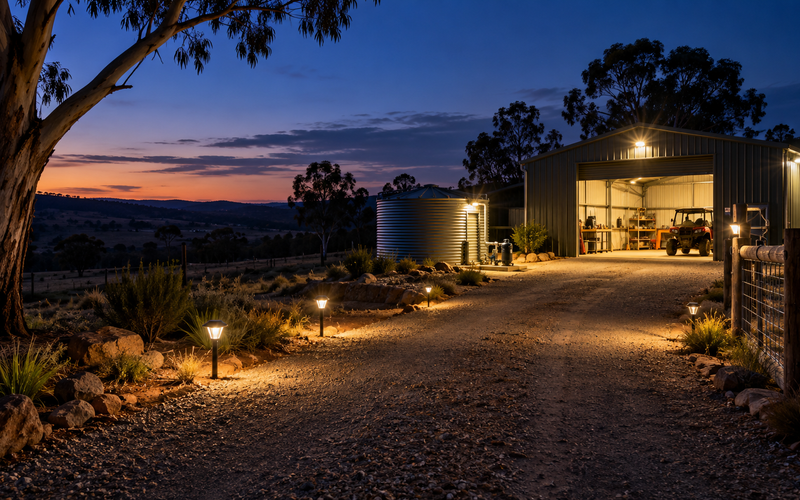
Solar pathway lights are low-output lights designed to mark pathways, garden edges and steps. They typically include a small integrated solar panel and a low-capacity battery, providing enough light to mark a path without illuminating a large area. Most activate automatically at dusk and switch off at dawn. Pathway lights are decorative and functional for marking routes but are not suitable as security or work lighting. They are easy to install — most simply push into the ground — and require no wiring.
Gate Lighting
Gate lighting serves both practical and security purposes — illuminating the gate area for access at night and providing a visible deterrent. Solar floodlights with PIR motion sensing are well suited to gate lighting, activating when a vehicle or person approaches. For a remote gate, a solar light with a separate panel allows the panel to be positioned for maximum sun exposure while the light is mounted at the gate. Battery capacity should be sufficient to operate through consecutive cloudy days if the gate is in regular use.
Shed Lighting
Shed lighting requirements depend on how the shed is used. For occasional access at night, a PIR-triggered solar floodlight above the door provides adequate illumination. For a working shed or workshop, higher-output lighting that illuminates the full interior is needed. Solar-powered shed lighting systems using a roof-mounted panel and internal LED lights are available for sheds without mains power. For a shed used regularly for detailed work, a dedicated solar and battery system with appropriate LED lighting provides more reliable and consistent illumination than a standalone solar light.
Driveway Lighting
Driveway lighting on a rural property serves both practical and safety purposes. Solar lights positioned along the driveway edge mark the route and illuminate the surface for driving at night. For a long driveway, multiple lights spaced at regular intervals provide consistent coverage. PIR-triggered floodlights at the driveway entrance provide brighter illumination when a vehicle enters. Consider the driveway length, surface type and whether lighting is needed along the full length or only at key points such as the entrance and any bends.
Motion-Activated Lighting
Motion-activated lighting conserves battery by only illuminating when triggered. PIR sensors detect movement and activate the light for a set period — typically 20–60 seconds. This is well suited to areas that are accessed occasionally, such as gates, shed entrances and outbuilding access points. For areas in regular use, dusk-to-dawn lighting may be more practical. Sensitivity and timer settings should be adjusted to suit the location — a high-sensitivity setting near vegetation or in an area with wildlife may produce frequent false triggers.
Battery-Powered Lighting
Battery-powered lights that are not solar-charged are useful for temporary or portable lighting needs — illuminating a work area, providing emergency lighting or supplementing solar lighting during extended cloudy periods. Rechargeable battery lights can be charged from a vehicle, generator or solar system. For permanent installations, solar charging is generally more practical than relying on manual battery charging.
Timers and Dusk-to-Dawn Controls
Timers allow lights to be set to operate during specific hours — for example, from dusk until midnight — rather than all night. This conserves battery and extends the life of the lighting system. Dusk-to-dawn sensors automatically activate lights at sunset and deactivate them at sunrise. Many solar lights include a built-in dusk-to-dawn sensor. Programmable timers are available for more complex lighting schedules.
Solar Panel Positioning
Solar panel performance depends on sun exposure. In Australia, panels should face north for maximum year-round output. Avoid shading from trees, buildings or other structures during peak sun hours (roughly 10am–3pm). In southern Australia, the sun angle is lower in winter, which reduces output from panels mounted at a fixed angle. Adjustable panel mounts allow the angle to be optimised for seasonal sun angles. Panels should be kept clean — dust and bird droppings reduce output.
Battery Storage
The battery in a solar lighting system stores energy collected during the day for use at night. Battery capacity determines how many nights the system can operate without adequate sun. For reliable operation through consecutive cloudy days, a larger battery capacity is needed. Lithium batteries offer better performance in temperature extremes and longer cycle life than lead-acid batteries. Battery temperature affects performance — very cold temperatures reduce capacity, while very high temperatures accelerate degradation.
Weatherproof Housings
Outdoor lighting on a rural property is exposed to sun, rain, dust, insects and temperature extremes. Look for lights with appropriate IP ratings — IP65 or higher for exposed outdoor locations. UV-resistant housings are important in the Australian climate, where UV exposure can degrade plastic components over time. Stainless steel or powder-coated aluminium housings offer better long-term durability than untreated plastic in harsh outdoor environments.
Low-Voltage Systems
Low-voltage (12V or 24V) outdoor lighting systems are an alternative to mains-voltage lighting for rural properties with an existing solar and battery system. Low-voltage LED lights can be connected directly to a 12V battery system, eliminating the need for an inverter. Wiring is simpler and safer than mains-voltage wiring. Low-voltage systems are well suited to properties with an existing off-grid power system that can supply the additional load.
Lighting Around Water Tanks, Pumps and Outbuildings
Water tanks, pumps and outbuildings on rural properties often require occasional access at night. A PIR-triggered solar light positioned to illuminate the access area provides practical lighting without requiring a permanent power connection. For pump sheds and equipment areas, consider whether the light needs to illuminate the interior as well as the exterior. Ensure lights near water infrastructure are rated for outdoor use and positioned to avoid direct water spray from pumps or irrigation equipment.
Emergency Lighting
Emergency lighting provides illumination during a power outage or other emergency. For a rural property, a rechargeable lantern or work light kept charged provides a practical emergency light source. A solar-powered light that operates independently of the main property power system provides a reliable backup. Consider positioning an emergency light where it is easily accessible in the dark — near the main entry or in a central location.
Decorative vs Security and Work Lighting
There is an important practical difference between decorative pathway lights and higher-output security or work lighting. Decorative pathway lights are low-output, designed to mark routes and add visual interest — they do not provide adequate illumination for security or work tasks. Security and work lighting requires significantly higher output, appropriate beam spread and reliable triggering. Choosing the right type of light for each application avoids the disappointment of installing decorative lights where functional lighting is needed. For permanent electrical installations, use appropriately licensed electrical professionals where required under Australian regulations.
Off-Grid Rural Property Lighting Applications
| Application | Recommended Type | Key Feature | Notes |
|---|---|---|---|
| Pathway marking | Solar pathway lights | Dusk-to-dawn | Decorative, low output |
| Gate and driveway entry | Solar PIR floodlight | Motion sensing | Separate panel if shaded |
| Shed access | Solar PIR floodlight | PIR trigger | Higher output for working shed |
| Driveway length | Multiple solar lights | Spaced coverage | Consistent spacing |
| Water tanks and pumps | Solar PIR light | Weatherproof housing | Avoid water spray |
Affiliate Disclosure: Country Heart Outdoors participates in affiliate programs. If you purchase through our links, we may earn a commission at no extra cost to you. This helps support our free buying guides.