Off-Grid Hot Water: Solar vs Gas vs Electric
Choosing a hot-water system for off-grid use involves more trade-offs than most people expect. The right choice depends on how you use hot water, what energy sources you have available, how long you stay in one place, and how much complexity you are willing to manage. This guide compares the three main options — solar, LPG gas and electric — across the factors that matter most for camping, caravanning, tiny homes and off-grid properties.
Affiliate disclosure: We may earn a commission if you purchase through our links, at no extra cost to you. Learn more.
Solar Hot Water
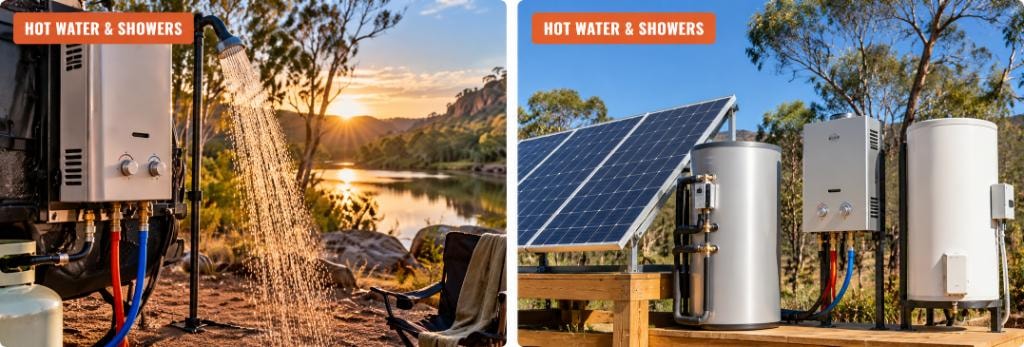
Solar hot-water systems use energy from the sun to heat water, either through a flat-plate or evacuated-tube collector mounted on a roof or frame, or through a simple solar shower bag. Roof-mounted solar collectors are most practical for permanent or semi-permanent off-grid properties and some larger caravans. They heat water stored in an insulated tank, which is then drawn off as needed. A solar shower bag is a much simpler option for camping — fill it with water, leave it in the sun for a few hours, and gravity-feed a basic shower. Output depends entirely on sunlight availability, so cloudy days and cold climates reduce performance. Most roof-mounted solar systems include a gas or electric booster to cover periods of low solar input.
LPG Gas Instant Systems
LPG instant hot-water heaters are the most widely used option for off-grid camping and caravanning in Australia. They heat water on demand using a gas burner, with no storage tank required. Cold water flows through a heat exchanger above the burner and exits hot. Because there is no tank to deplete, hot water is available continuously for as long as gas and water supply last. Portable units run from a standard LPG bottle and a 12V pump, making them straightforward to set up and move between sites. Gas instant systems are outdoor-only appliances — they produce combustion gases and must never be used in an enclosed space. LPG supply logistics — bottle weight, refill access and storage — are the main practical consideration for extended trips.
Electric Storage Systems
Electric storage hot-water systems heat water in an insulated tank using an electric heating element. The element heats the full tank to a set temperature, and hot water is drawn off as needed until the tank is depleted, at which point recovery time is required. The heating element typically operates at 1,200–3,600 W or more depending on the unit, which means electric storage systems place a substantial load on a battery bank and inverter. They are best suited to setups with a large solar and battery system, reliable generator access, or connection to shore power. Recovery time — the time needed to reheat a depleted tank — varies with element wattage and tank size. A well-insulated tank retains heat for many hours, which can reduce the frequency of reheating if hot water use is managed carefully.
240V Electric Systems
240V electric hot-water systems — whether storage or continuous-flow — require either mains power, a generator, or a large inverter fed by a substantial battery bank. Continuous-flow 240V units heat water instantly but draw very high wattage during operation, typically 3,500–5,500 W or more, which is beyond the capacity of most off-grid battery and inverter setups without careful sizing. Storage 240V systems draw high wattage during the heating cycle but can be scheduled to heat during generator run time or peak solar production. For most off-grid and camping applications, 240V electric systems are a secondary or backup option rather than a primary hot-water source, unless the property has a large and well-designed power system.
Energy Use and Running Costs
LPG gas instant systems consume gas only while the burner is active, making running costs relatively predictable based on shower duration and frequency. Solar systems have negligible running costs once installed, though the capital cost of a roof-mounted system is significant. Electric storage and 240V systems consume electricity in proportion to the volume of water heated and the element wattage; when electricity comes from a generator, this translates directly to fuel cost and generator run hours. For off-grid battery systems, the energy drawn by an electric heater must be factored into daily energy budgets alongside other loads. In most off-grid scenarios, LPG gas offers the most predictable and manageable running cost for a primary hot-water source.
Setup Complexity
A portable LPG instant heater is among the simplest hot-water setups to install — connect a gas hose to a bottle, connect a 12V pump to the water supply, and mount the unit outdoors. A solar shower bag requires no installation at all. Roof-mounted solar systems involve plumbing, mounting, and often a booster connection, making them a more involved installation suited to permanent or semi-permanent setups. Electric storage systems require plumbing, a weatherproof enclosure, and either a 240V connection or an inverter output. The more complex the system, the more points of potential failure and the more knowledge required to maintain it.
Water Flow and Recovery Time
LPG instant systems deliver hot water immediately and continuously, with no recovery time. Flow rate is typically 5–8 L/min for portable units. Solar shower bags deliver water by gravity at a low flow rate — usually 1–3 L/min — and require several hours of sun exposure to heat. Roof-mounted solar storage systems deliver hot water at normal flow rates until the tank is depleted, then require recovery time that depends on solar input. Electric storage systems behave similarly — full tank available on demand, then a recovery period of 30 minutes to several hours depending on element wattage and tank size. Recovery time is an important practical consideration for households or groups with staggered shower schedules.
Suitability for Different Use Cases
For camping and overlanding, a portable LPG instant heater or solar shower bag suits most situations. The LPG unit provides reliable hot water regardless of weather; the solar bag works well in sunny conditions with minimal gear. For caravans and motorhomes, a semi-permanently mounted LPG instant heater is the most common choice, with some larger rigs using a roof-mounted solar system with a gas booster. For tiny homes and off-grid properties, the choice depends on the scale of the solar and battery system. A well-sized solar system with a large battery bank can support an electric storage system; properties with limited solar capacity are better served by LPG or a solar collector with a gas booster. In all cases, matching the system to the available energy source and daily hot-water demand is more important than the technology itself.
Pros and Cons of Each System
LPG instant: continuous hot water on demand, simple setup, portable, outdoor-only, dependent on gas supply logistics. Solar shower bag: free to run, no moving parts, weather-dependent, low flow rate, limited volume. Roof-mounted solar storage: low running cost, weather-dependent, significant capital cost, requires booster for cloudy periods, not suited to mobile use. Electric storage: independent of gas supply, high energy draw, requires large power system or generator, recovery time after depletion. 240V continuous-flow electric: instant hot water, very high wattage draw, requires large inverter or mains/generator power, not practical for most off-grid setups without careful system sizing.
Choosing the Right System
If you camp or travel frequently and want reliable hot water with minimal complexity, a portable LPG instant heater is the most practical starting point. If you are setting up a permanent or semi-permanent off-grid property with a substantial solar system, a solar collector with a gas or electric booster gives the lowest long-term running cost. If you are on a tight budget or only need occasional hot water, a solar shower bag covers basic needs at minimal cost. Electric storage and 240V systems suit off-grid properties where the power system is already sized for high loads, or where generator run time can be scheduled around hot-water demand. In most cases, the best system is the one that matches your energy source, your daily hot-water volume, and the level of complexity you are comfortable managing.
Off-Grid Hot Water Systems Compared
| System Type | Energy Source | Flow / Recovery | Setup Complexity | Best Suited To |
|---|---|---|---|---|
| LPG Instant | LPG gas bottle | 5–8 L/min, no recovery | Low — portable | Camping, caravans, off-grid |
| Solar Shower Bag | Sunlight | 1–3 L/min gravity, 3–4 hr heat-up | None | Camping, backup use |
| Roof Solar Storage | Sunlight + booster | Normal flow, recovery if depleted | High — plumbing + mounting | Off-grid properties, large caravans |
| Electric Storage | 240V / inverter | Normal flow, 30 min–2 hr recovery | Medium — plumbing + power | Off-grid properties with large solar/battery |
| 240V Continuous-Flow | 240V / large inverter | Instant, 3,500–5,500 W draw | Medium — power sizing critical | Powered sites, large off-grid power systems |
Affiliate Disclosure: Country Heart Outdoors participates in affiliate programs. If you purchase through our links, we may earn a commission at no extra cost to you. This helps support our free buying guides.