How Big a Portable Power Station Do I Need?
Portable power stations have become one of the most useful pieces of kit for campers, caravanners and anyone living off-grid. But the specs can be confusing — watt-hours, inverter watts, surge ratings, solar input. This guide cuts through the jargon and helps you figure out exactly what size unit you actually need.
Affiliate disclosure: We may earn a commission if you purchase through our links, at no extra cost to you. Learn more.
Watt-Hours: How Much Energy Can It Store?
Watt-hours (Wh) is the most important number on any portable power station. It tells you how much total energy the battery can store. Think of it like the fuel tank — a bigger number means more energy available before you need to recharge.
As a rough rule: a 500Wh unit is a solid starting point for weekend camping. A 1000–1500Wh unit suits most caravanners running a fridge, lights and devices. A 2000Wh+ unit is better suited to tiny homes, extended off-grid stays or running larger appliances.
Keep in mind that real-world capacity is slightly less than the rated figure due to conversion losses — typically 85–90% of the rated Wh is usable.
Inverter Watts: How Much Can It Run at Once?
The inverter watt rating tells you the maximum power the unit can deliver to 240V appliances at any one moment. This is separate from storage capacity — a unit might store 1000Wh but only deliver 1000W continuously.
For most camping and caravan use, a 1000–1500W inverter is sufficient. If you want to run a small air conditioner, induction cooktop or electric kettle, look for 2000W or more. Always add up the running watts of everything you plan to use at the same time and make sure the inverter rating exceeds that total.
Surge Power: Why Starting Loads Matter
Appliances with motors — fridges, pumps, air conditioners — draw 2 to 5 times their running wattage for a fraction of a second when they start up. This is called the surge or starting load.
For example, a portable air conditioner might run at 700W but surge to 2100W on startup. If your inverter's surge rating is only 1500W, it will trip and the air conditioner won't start — even though the running load is well within range.
Always check the surge (peak) watt rating of your power station and compare it to the starting loads of your appliances, not just their running watts. This is especially important for fridges, water pumps and air conditioners.
Solar Charging: Matching Panels to Your Power Station
Most portable power stations accept solar input via a solar connector (type varies by model — check your unit's specifications). The solar input rating (in watts) tells you the maximum panel wattage the unit can accept at once.
To size your solar, aim to generate at least as many watt-hours per day as you consume. A 200W panel in 4–5 hours of good sun produces roughly 800–1000Wh — enough to cover moderate daily use. If you're running a fridge continuously, add another 100–200W of panels to account for cloudy days and inefficiency.
Higher solar input ratings mean faster recharge on sunny days. If you're relying on solar as your main charging source, prioritise a unit with a high solar input rating over one that only charges quickly from mains power.
Common Appliances and Approximate Power Requirements
The table below shows typical power draws for common appliances. These are approximate figures — actual consumption varies by brand, model, age, ambient temperature and usage pattern. Always check the label or manual of your specific appliance for accurate figures.
Use these numbers as a starting point for estimating your daily watt-hour needs, not as guaranteed values.
Fridges
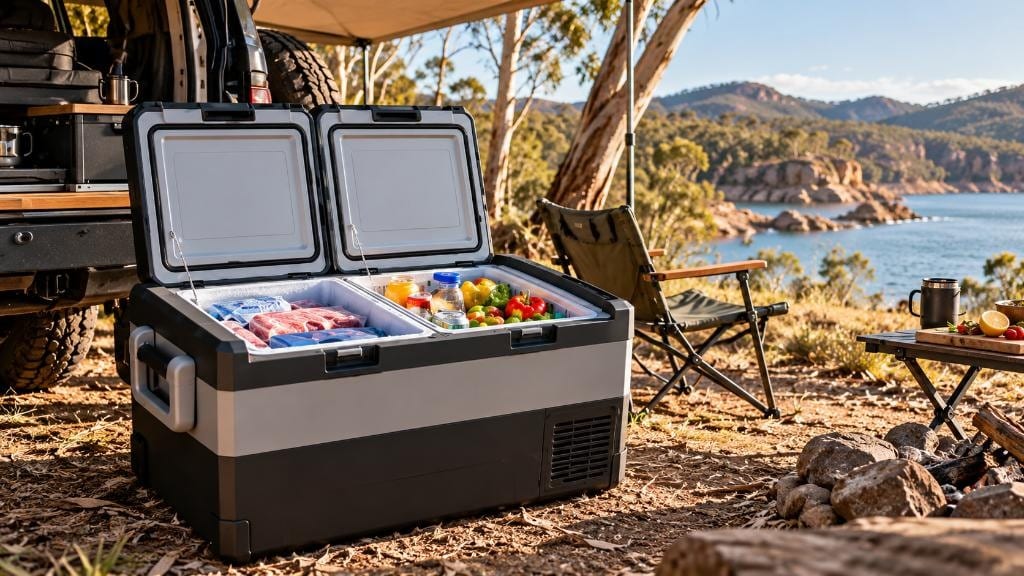
A 40–60L compressor fridge typically draws 30–60W while running, but only runs 30–50% of the time in moderate temperatures. Average consumption is roughly 300–600Wh per 24 hours depending on ambient temperature and how often the lid is opened. In hot Australian summer conditions, consumption can be significantly higher. A 1000Wh power station with solar top-up will comfortably run a quality compressor fridge around the clock.
Lights
LED lighting is very efficient. A set of four 10W LED lights draws just 40W total — negligible compared to a fridge or air conditioner. Even running lights for 6 hours uses only 240Wh. Lighting alone will not significantly drain a mid-sized power station.
Water Pumps
A 12V water pump typically draws 60–120W while running, but only operates for short bursts. Total daily consumption for a caravan or tiny home water pump is usually 50–150Wh — very manageable. The main consideration is surge power: pumps can draw 3–4x their running wattage on startup, so check the surge rating of your power station.
TVs and Entertainment
A 32–40" LED TV draws roughly 40–80W. Watching 3 hours of TV per evening uses around 120–240Wh — well within the capacity of most mid-sized power stations. Laptops draw 45–90W and can run for 8–12 hours from a 500Wh unit. Phones, tablets and small speakers draw very little power and are easy to keep charged from even a compact unit.
CPAP Machines
CPAP machines are a common concern for campers and caravanners. Most CPAP machines draw 30–60W without a humidifier, or 60–100W with one. A full night's use (8 hours) typically consumes 240–500Wh. A 500Wh power station will comfortably run a CPAP for one night; a 1000Wh unit gives you two nights of buffer. Some CPAP machines also accept 12V DC input directly, which is more efficient than running through the inverter.
Small Portable Air Conditioners
Small portable air conditioners are the most demanding appliance you're likely to run from a portable power station. Running watts typically range from 600–1200W, with surge loads of 1500–3000W on startup. Running a small air conditioner for 8 hours overnight could consume 5000–9600Wh — far beyond what most portable power stations can store.
For short periods of cooling (1–2 hours to cool a van before sleep), a 2000Wh+ unit with a 2000W+ inverter and adequate surge rating may be sufficient. For overnight air conditioning, you'll need a large battery system with substantial solar or mains charging. Always verify the surge rating of both the air conditioner and the power station before purchasing.
How to Estimate Your Daily Watt-Hour Needs
Add up the running watts of each appliance and multiply by the hours per day you plan to use it. This gives you watt-hours (Wh) per day for each appliance. Add them all together for your total daily consumption estimate.
Example: Fridge (45W average × 24h) = 1080Wh. Lights (40W × 4h) = 160Wh. Laptop (65W × 3h) = 195Wh. Phone charging (10W × 2h) = 20Wh. Total: approximately 1455Wh per day.
Add 20–30% buffer for inefficiency and unexpected use. In this example, a 2000Wh power station with adequate solar input would comfortably cover daily needs. These are example figures only — your actual appliances and usage will differ.
Choosing the Right Size: A Simple Summary
Weekend camper running phones, lights and a small fridge: 500–800Wh with a 1000W inverter is a practical starting point. Caravanner running a fridge, lights, devices and occasional TV: 1000–1500Wh with a 1500W inverter and 200–400W of solar. Tiny home or extended off-grid stay: 2000Wh+ with expandable battery options and 400W+ of solar. Emergency home backup for essentials: 1500–3000Wh depending on what you need to keep running.
Remember that these are general guidelines. Your actual needs depend on your specific appliances, how long you use them, the climate you're in and how much solar charging you have available. When in doubt, size up — it's much easier to have more capacity than you need than to run out of power in the middle of nowhere.
Approximate Daily Power Consumption by Appliance
| Appliance | Typical Running Draw | Est. Daily Use | Approx. Daily Wh |
|---|---|---|---|
| Compressor fridge (40–60L) | 30–60W | 24 hours | 300–600Wh |
| LED lights (4 × 10W) | 40W | 4–6 hours | 160–240Wh |
| 12V water pump | 60–120W | Short bursts | 50–150Wh |
| Laptop | 45–90W | 3–4 hours | 135–360Wh |
| 32–40" LED TV | 40–80W | 2–3 hours | 80–240Wh |
| CPAP (no humidifier) | 30–60W | 8 hours | 240–480Wh |
| CPAP (with humidifier) | 60–100W | 8 hours | 480–800Wh |
| Phone charging | 10–18W | 2 hours | 20–36Wh |
| Small portable air con | 600–1200W | 1–2 hours | 600–2400Wh |
| Induction cooktop (1 burner) | 1000–1800W | 30 min | 500–900Wh |
Affiliate Disclosure: Country Heart Outdoors participates in affiliate programs. If you purchase through our links, we may earn a commission at no extra cost to you. This helps support our free buying guides.