GPS, Satellite Communicators, PLBs & EPIRBs — Australian Buying Guide 2026
When you head beyond mobile phone coverage in Australia — whether you're deep in the outback, navigating a remote 4WD track or hiking in the high country — reliable navigation and emergency communication become genuinely life-critical. A smartphone with a downloaded map is a useful backup, but it is not a substitute for a dedicated GPS unit or a registered emergency beacon. This guide covers the four key categories of navigation and safety devices for Australian outdoor use: handheld GPS units, satellite communicators, PLBs and EPIRBs. Understanding the differences between these devices — and knowing which combination suits your style of travel — could make all the difference in a remote emergency.
Affiliate disclosure: We may earn a commission if you purchase through our links, at no extra cost to you. Learn more.
Handheld GPS Navigation
Dedicated handheld GPS units offer significant advantages over smartphone navigation for serious Australian 4WD touring, camping and bushwalking. Unlike a smartphone, a purpose-built GPS unit is designed to operate in extreme heat, dust, rain and direct sunlight — conditions that routinely degrade smartphone performance and battery life in the Australian bush.
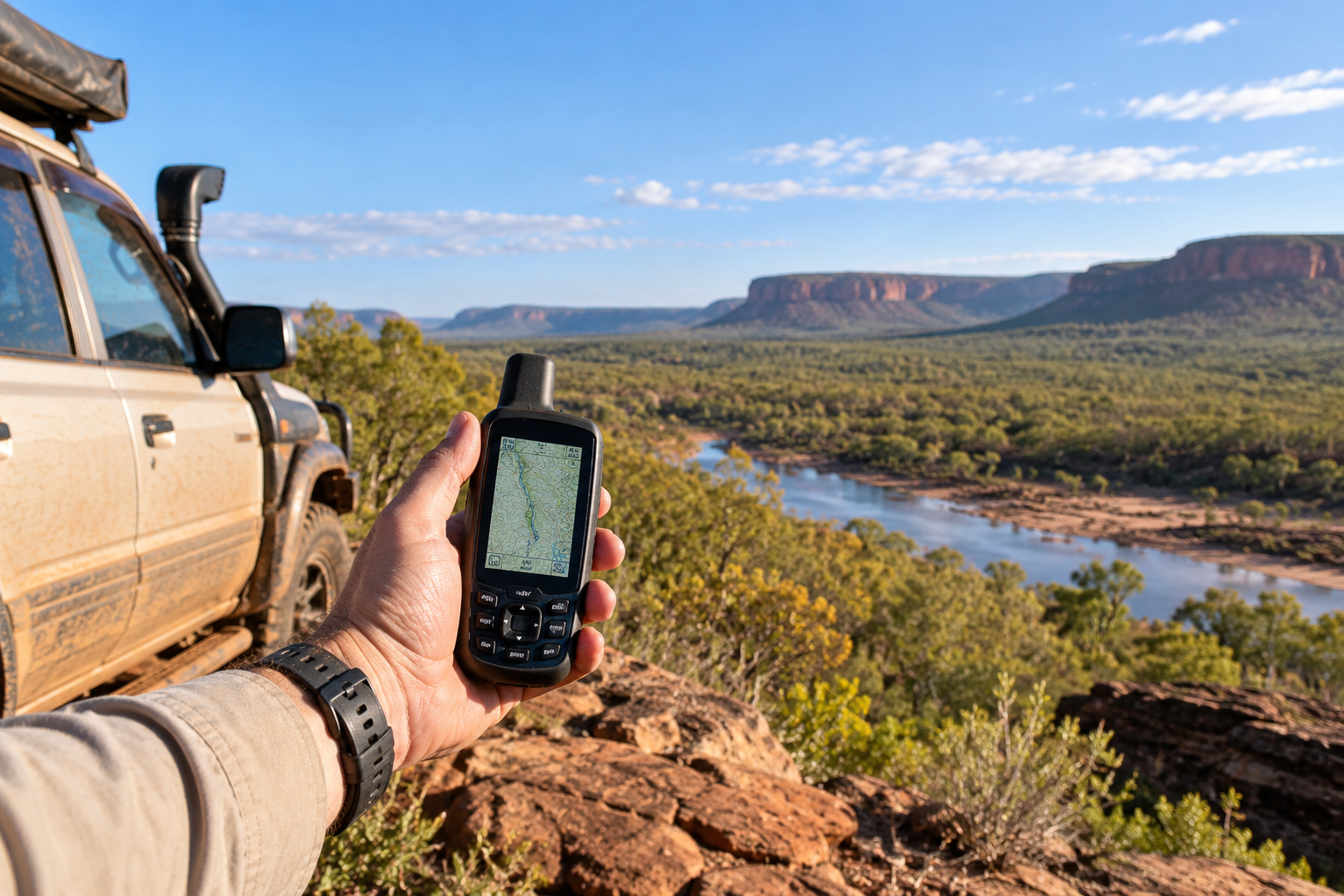
Garmin is the dominant brand in the Australian handheld GPS market, and for good reason. The Garmin GPSMAP series — including the GPSMAP 67 and GPSMAP 66i — are rugged, waterproof units designed for demanding outdoor use. They accept detailed topographic maps of Australia (including Garmin's own 1:100,000 topo maps and third-party datasets), display your position on a moving map, and allow you to mark waypoints, record tracks and navigate to a destination even without a mobile signal. Battery life varies by model and settings — check the manufacturer's specifications for your specific unit — far exceeding what a smartphone can manage in the field.
The Garmin eTrex series offers a more compact and affordable entry point. The eTrex 32x and eTrex SE are lightweight, rugged units well suited to bushwalking and hiking where pack weight matters. They lack some of the advanced features of the GPSMAP series but provide reliable navigation at a lower price point.
For 4WD touring specifically, a dedicated in-vehicle GPS unit (such as the Garmin GPSMAP 276Cx) or a tablet-based solution running dedicated mapping software (such as Hema Explorer or Avenza Maps) is often preferred over a handheld unit — the larger screen is easier to read while driving, and the mapping databases available for Australian 4WD tracks are more comprehensive. However, a handheld GPS remains an essential backup and is indispensable once you leave the vehicle on foot.
Key considerations when choosing a handheld GPS for Australian use: ensure the unit accepts detailed Australian topographic maps; confirm it is rated waterproof to at least IPX7; check that it runs on standard AA batteries (which can be purchased anywhere in Australia) rather than a proprietary rechargeable pack; and verify that the screen is readable in direct sunlight.
Satellite Communicators
Satellite communicators fill the critical gap between a GPS unit (which tells you where you are) and an emergency beacon (which calls for rescue). A satellite communicator lets you send and receive text messages, share your location with family or a trip monitor, and — in an emergency — trigger an SOS alert, all from anywhere in Australia with a clear view of the sky.
The two most widely used satellite communicator platforms in Australia are Garmin inReach and ZOLEO.
Garmin inReach devices — including the inReach Mini 2 and inReach Messenger — use the Iridium satellite network, which provides truly global coverage including polar regions. The inReach Mini 2 is a compact device that pairs with a smartphone via Bluetooth, allowing you to compose and send messages through the Garmin Messenger app. The inReach Messenger adds a built-in screen and keyboard for standalone use without a phone. Both devices allow two-way text messaging with any mobile number or email address, live location tracking that can be shared with nominated contacts, and a dedicated SOS button that connects you to the Garmin International Emergency Response Coordination Centre (Garmin Response), which coordinates with Australian emergency services on your behalf.
ZOLEO is an Australian-designed satellite communicator that uses the Iridium network and is specifically designed to work in conjunction with a smartphone. The ZOLEO device itself is compact and rugged; the companion app handles message composition and contact management. ZOLEO supports two-way messaging, check-in messages, automated location sharing and SOS. One notable feature is that ZOLEO provides a dedicated satellite phone number and email address, making it straightforward for contacts to reach you directly.
Both Garmin inReach and ZOLEO require an active subscription plan to operate. Plans vary in price and included message allowances — from basic safety plans (check-in messages and SOS only) to unlimited messaging plans for extended expeditions. It is essential to activate and test your subscription before departing on a trip, and to ensure your nominated emergency contacts understand how to respond to check-in messages and location shares.
Satellite communicators are not a substitute for a registered PLB or EPIRB. In a life-threatening emergency, a 406 MHz beacon activates the internationally recognised COSPAS-SARSAT distress system and alerts Australian Search and Rescue directly — no subscription, no intermediary, no battery-dependent two-way communication required. The two devices serve complementary roles: a satellite communicator for day-to-day communication and non-emergency situations; a PLB or EPIRB as the last-resort emergency device.
Personal Locator Beacons (PLBs)
A Personal Locator Beacon (PLB) is a one-way, manually activated distress device that transmits a 406 MHz emergency signal to the international COSPAS-SARSAT satellite system. When you activate a PLB, it transmits your GPS coordinates and a unique beacon identification code to a network of low-Earth orbit and geostationary satellites. Those satellites relay the alert to the nearest Rescue Coordination Centre — in Australia, this is the Joint Rescue Coordination Centre (JRCC Australia), operated by the Australian Maritime Safety Authority (AMSA). JRCC Australia then coordinates the appropriate search and rescue response, whether that involves police, State Emergency Service, volunteer search and rescue groups, or the Australian Defence Force.
A PLB is not a two-way messaging device. It does not allow you to communicate with rescuers, send a text message, or confirm that help is on the way. It does one thing: it tells the rescue system exactly where you are and that you need help. That simplicity is also its strength — there is no subscription to lapse, no app to open, no satellite network to connect to. You activate it, and the international rescue system responds.
For remote camping, bushwalking and 4WD touring in Australia, a registered PLB is widely regarded as the most reliable last-resort safety device available. Unlike a satellite communicator, a PLB does not depend on a paid subscription being active, a paired smartphone being charged, or a private company's emergency response centre being available. The COSPAS-SARSAT system is an internationally operated, government-backed infrastructure — it is monitored 24 hours a day, 365 days a year.
PLBs are compact enough to be carried on a person — clipped to a life jacket, worn on a lanyard, or stored in a pack hip belt pocket. Most current-generation PLBs from reputable manufacturers are waterproof to at least 5 metres, have a battery life of at least 24 hours of continuous transmission once activated, and include an integrated GPS receiver that transmits your precise location within approximately 100 metres. Without GPS integration, the COSPAS-SARSAT system can still locate a beacon to within approximately 5km using Doppler calculations — but GPS-enabled beacons dramatically reduce search time and are the standard for all current-generation devices.
PLBs are designed for personal use by an individual. They are not a substitute for a vessel-mounted EPIRB on a boat, and they are not designed for automatic float-free activation. For land-based remote travel — whether on foot, by vehicle or by bicycle — a PLB is the appropriate emergency beacon choice. Reputable Australian-market PLBs include models from GME (an Australian manufacturer), ACR Electronics, Ocean Signal and McMurdo. Always purchase from a reputable Australian retailer and confirm the unit is coded for Australian registration.
Emergency Position Indicating Radio Beacons (EPIRBs)
An EPIRB (Emergency Position-Indicating Radio Beacon) operates on the same 406 MHz COSPAS-SARSAT system as a PLB, but is designed specifically for maritime use. EPIRBs are larger than PLBs and are intended to be mounted in a bracket on a vessel — typically on the exterior of the wheelhouse or in an accessible deck location — rather than carried on a person.
The defining characteristic of a float-free EPIRB is its float-free, automatic activation capability. A float-free EPIRB is housed in a hydrostatic release bracket: if the vessel sinks, the bracket releases the EPIRB at a depth of 1–4 metres, the EPIRB floats to the surface, and it activates automatically. This means that even if the crew is incapacitated or the vessel sinks rapidly, the distress signal is still transmitted. manually activated EPIRBs are manually activated and do not have the float-free hydrostatic release mechanism. For most Australian recreational boating applications, a float-free EPIRB is the appropriate choice.
The key differences between a PLB and an EPIRB are: purpose (PLBs are personal devices for land or water use; EPIRBs are vessel-mounted marine devices); activation (PLBs are always manually activated; float-free EPIRBs can activate automatically on submersion); battery life (EPIRBs typically provide 48 hours of continuous transmission; PLBs typically provide 24 hours); and size (EPIRBs are larger and designed for vessel mounting, not personal carry).
An important point for Australian boaters: a PLB carried by a crew member is not a legal substitute for a mandatory EPIRB on a vessel where an EPIRB is required by law. Australian marine safety regulations specify the required safety equipment for different vessel classes and operating areas, and those requirements are set by the relevant state or territory marine safety authority. The rules differ between jurisdictions and vessel types — for example, the requirements for a recreational vessel operating in coastal waters differ from those for a commercial vessel operating offshore. If you operate a vessel in Australian waters, you should confirm the applicable equipment requirements with your state or territory marine safety authority. Carrying a PLB in addition to a mandatory EPIRB is sensible practice — it provides each person on board with their own personal distress capability — but it does not replace the vessel's required EPIRB.
Australian Registration and Safety Requirements
All 406 MHz distress beacons used in Australia — whether PLBs or EPIRBs — must be registered with AMSA (the Australian Maritime Safety Authority). Registration is free and is completed online through the Australian Beacon Registry at https://beacons.amsa.gov.au/
Registration links your beacon's unique 15-digit hexadecimal identification code to your personal details, emergency contacts, and — for EPIRBs — vessel information. When your beacon is activated, JRCC Australia can immediately access your registration details to identify who you are, contact your nominated emergency contacts, and obtain any relevant vessel or trip information that assists the rescue response. An unregistered beacon will still trigger a rescue response, but the response will be slower and less targeted — rescuers will not know who activated the beacon, how many people may be involved, or what vessel or vehicle to look for.
A significant change took effect on 4 November 2024: AMSA beacon registrations no longer expire. Prior to this date, registrations expired every two years and owners were required to renew them. Under the current system, your registration remains active indefinitely — but this does not mean you can set and forget it. It remains your responsibility to keep your registration details current. If you change your emergency contacts, update your vessel details, move to a new address, or change your phone number, you must update your registration accordingly. Outdated contact information can delay a rescue response at the worst possible time.
Beyond registration, there are two ongoing maintenance requirements that beacon owners must not overlook. First, battery expiry: all PLBs and EPIRBs have a battery expiry date printed on the device, typically 5–10 years from manufacture depending on the model. The battery must be replaced before this date — an expired battery may not provide the full transmission time required in an emergency. Battery replacement must be carried out by an authorised service centre, as the beacon must be retested and recertified after the battery is replaced. Second, manufacturer testing requirements: some beacon models have periodic self-test or service requirements specified by the manufacturer. Check your beacon's documentation and comply with any recommended service intervals.
Distress beacons are intended for genuine life-threatening emergencies only. Activating a beacon when there is no emergency — including accidental activation — triggers a real search and rescue response at significant cost and risk to rescue personnel. If you accidentally activate your beacon, contact AMSA immediately on 1800 641 792 to cancel the response. Always store your beacon carefully to prevent accidental activation, and test it only using the self-test function (which does not transmit a live distress signal) rather than a full activation.
For registration, renewal of contact details, and further information on Australian beacon requirements, visit the Australian Beacon Registry: https://beacons.amsa.gov.au/
GPS & Satellite Device Comparison
| Device Type | Primary Use | Two-Way Comms | Subscription Required | Emergency SOS |
|---|---|---|---|---|
| Handheld GPS (e.g. Garmin GPSMAP) | Navigation & mapping | No | No | No |
| Satellite Communicator (e.g. inReach) | Messaging & tracking | Yes | Yes | Yes (via Garmin Response) |
| PLB (e.g. GME MT410G) | Emergency distress only | No | No | Yes (direct COSPAS-SARSAT) |
| EPIRB (marine) | Marine emergency distress | No | No | Yes (direct COSPAS-SARSAT) |
Affiliate Disclosure: Country Heart Outdoors participates in affiliate programs. If you purchase through our links, we may earn a commission at no extra cost to you. This helps support our free buying guides.