Fishing Gear for Camping & 4WD Touring — Australian Buying Guide 2026
Fishing is one of the great pleasures of the Australian outdoors — and for campers, caravanners and 4WD tourers, it is often a central part of the trip. Whether you are chasing barramundi in a remote Top End billabong, casting for bream off a coastal estuary, or flicking lures for golden perch in an inland impoundment, having the right gear with you makes all the difference. The challenge for travelling anglers is that space and weight are limited. A full rod rack and a boot full of tackle boxes is not practical when you are packing a 4WD or caravan for a multi-week trip. This guide covers how to choose practical, portable fishing equipment that travels well — from multi-piece and telescopic travel rods to compact spinning reels, the right line setup, and a streamlined tackle selection that covers most Australian fishing situations without taking up half your storage.
Affiliate disclosure: We may earn a commission if you purchase through our links, at no extra cost to you. Learn more.
Fishing Rods for Travelling Anglers
The biggest challenge with fishing rods for camping and 4WD touring is length versus portability. A standard one-piece 7ft spinning rod is excellent on the water but impossible to pack into a 4WD without a roof rack rod holder or a purpose-built rod tube strapped to the outside of the vehicle. For most travelling anglers, a multi-piece or telescopic rod is a far more practical choice.
Travel rods (multi-piece): A quality multi-piece travel rod breaks down into four, five or six sections, each typically 50–70cm long, and packs into a compact carry tube. Modern multi-piece travel rods from reputable brands — Shimano, Daiwa, Ugly Stik and Okuma all produce well-regarded options — are made from the same graphite and fibreglass composites as standard rods and perform very close to a one-piece equivalent. The ferrule joints (where the sections connect) are the critical point: look for spigot ferrules or over-ferrule designs that maintain the rod's action through the joint. A 4-piece 7ft medium-light spinning rod in a hard carry tube is an excellent all-round choice for estuary, freshwater and light saltwater fishing from a campsite or riverbank.
Telescopic rods: Telescopic rods collapse down to as little as 40–50cm and extend to full fishing length in seconds. They are extremely compact and convenient — they can be stored in a side pocket of a backpack or slipped into a door pocket in the 4WD. The trade-off is that most telescopic rods have more ferrule joints than a multi-piece rod, which can reduce sensitivity and action consistency. Budget telescopic rods are often poor quality, with weak guides and unreliable ferrules. If you choose a telescopic rod, invest in a quality option from a reputable brand — the Daiwa Presso and Shimano Catana telescopic models are well regarded in the Australian market. Telescopic rods are best suited to bait fishing and light lure work rather than demanding lure techniques that require precise rod action.
Multi-piece rods vs telescopic rods: For serious anglers who want to fish effectively on every trip, a quality 4-piece travel rod is the better choice — it performs closer to a standard rod and is more durable over time. For casual anglers who want a compact backup rod for opportunistic fishing, a quality telescopic rod is a practical and affordable option. Many experienced travelling anglers carry both: a quality 4-piece rod as their primary fishing rod, and a compact telescopic as a backup or for kids.
Rod action and power for travelling anglers: A medium-light to medium power rod with a fast to moderate-fast action is the most versatile choice for general Australian camping and touring fishing. This covers estuary species (bream, flathead, whiting, bass), freshwater species (golden perch, Murray cod, bass) and light saltwater work. If you are specifically targeting barramundi or large saltwater species, a medium-heavy rod is more appropriate — but for most general-purpose travelling fishing, medium-light to medium covers the widest range of situations.
Spinning Reels: Sizing and Saltwater Resistance
For most travelling anglers, a quality spinning reel (also called a threadline reel) is the most practical choice. Spinning reels are easy to use, cast light lures and baits well, and are suited to a wide range of species and techniques. They sit below the rod and are operated with the non-dominant hand on the handle.
Reel sizing: Spinning reels are sized by a number that roughly corresponds to the spool diameter and line capacity — common sizes for Australian recreational fishing are 1000, 2500, 3000, 4000 and 5000. For a general-purpose travel rod setup targeting estuary and freshwater species, a 2500 or 3000 size reel is the most versatile choice. It is large enough to hold adequate line for most situations, light enough not to unbalance a medium-light rod, and compact enough to pack easily. A 4000 or 5000 size reel is more appropriate if you are specifically targeting larger species such as barramundi, snapper or larger saltwater fish.
Saltwater resistance: If you are fishing in saltwater — estuaries, beaches, coastal rivers or offshore — saltwater resistance is an important consideration. Salt is highly corrosive to metal components, and a reel that is not designed for saltwater use will deteriorate quickly. Look for reels with sealed or shielded bearings, a corrosion-resistant body (aluminium or high-grade composite), and a sealed drag system. Most mid-range and premium reels from Shimano and Daiwa include some level of saltwater protection — look for designations such as Shimano's X-Shield or Daiwa's Mag Sealed technology. Regardless of the reel's saltwater rating, always rinse your reel thoroughly with fresh water after every saltwater session and allow it to dry completely before storing.
Matching reels to rods: A reel that is too heavy will unbalance the rod and cause fatigue over a long session; a reel that is too light may not have adequate line capacity or drag strength for larger fish. As a general guide: a 2500 size reel suits a 6–7ft light to medium-light rod; a 3000 size reel suits a 7ft medium-light to medium rod; a 4000 size reel suits a 7–8ft medium to medium-heavy rod. Most rod manufacturers specify a recommended reel size range on the rod blank or in the product specifications — follow this guidance when pairing components.
Budget guidance: For a travelling angler who wants reliable performance without spending a premium, the Shimano Sienna and Daiwa Revros ranges offer good value at the entry level ($50–$100). The Shimano Stradic and Daiwa Freams represent a significant step up in quality ($150–$250) and are well suited to anglers who fish regularly. Avoid the cheapest no-name reels — the drag systems and bearings are often poor quality and will frustrate rather than encourage fishing.
Fishing Line & Tackle for Travelling Anglers
A streamlined line and tackle setup is essential for travelling anglers. You do not need to carry every lure and rig in the tackle shop — a well-chosen selection of versatile items covers most Australian fishing situations and fits into a compact tackle wallet or small box.
Braided line: Most Australian lure anglers now use braided line (PE braid) as their main line. Braid has a much smaller diameter than monofilament at the same breaking strain, which means more line on the spool and better sensitivity. It has virtually no stretch, which improves hook-setting and lure feel. For a general-purpose 2500–3000 size reel, 10–15lb braid (PE 1.0–1.5) is a practical choice that covers most estuary and freshwater fishing. Braid is more visible in the water than monofilament, so always use a leader.
Monofilament: Monofilament is still widely used for bait fishing and as a leader material. It has good knot strength, some stretch (which can be an advantage when fighting fish on treble hooks), and is less visible than braid. For bait fishing with a simple running sinker rig, a 6–10lb monofilament main line is a practical and affordable choice. For a leader on a braid setup, 10–20lb monofilament or fluorocarbon is appropriate for most estuary and freshwater species.
Fluorocarbon leaders: Fluorocarbon has a refractive index close to water, making it nearly invisible underwater — it is the preferred leader material for clear-water fishing and wary species such as bream and trout. It is stiffer than monofilament and more abrasion-resistant, which is useful when fishing around rocks, oysters or timber. For a travelling angler, a small spool of 10–20lb fluorocarbon covers most leader situations.
Hooks: A compact selection of hooks covers most bait fishing situations. For general estuary and freshwater bait fishing, a selection of long-shank hooks in sizes 4–1/0 covers most bait presentations. Circle hooks are worth including — they are now mandatory for some species and fishing methods in certain Australian states, and they significantly improve survival rates for released fish. Carry a small selection of sizes 1–2/0 for general bait fishing.
Sinkers: A small selection of running sinkers (ball or bean sinkers) in 5g, 10g and 20g covers most bait fishing situations from a bank or beach. Snap swivels in sizes 10–14 allow quick rig changes and prevent line twist.
Lures: For a compact lure selection that covers a wide range of Australian species, consider: a small selection of soft plastic grubs or paddle tails in 2–3 inch sizes (white, chartreuse and natural colours) on 1/8 and 1/4 oz jig heads; two or three hard-body minnow lures in 50–80mm sizes (a floating and a sinking model); and a small selection of metal slugs or blades in 10–20g for casting distance and versatility. This compact selection fits into a small tackle wallet and covers bream, flathead, bass, golden perch, barramundi and many other species.
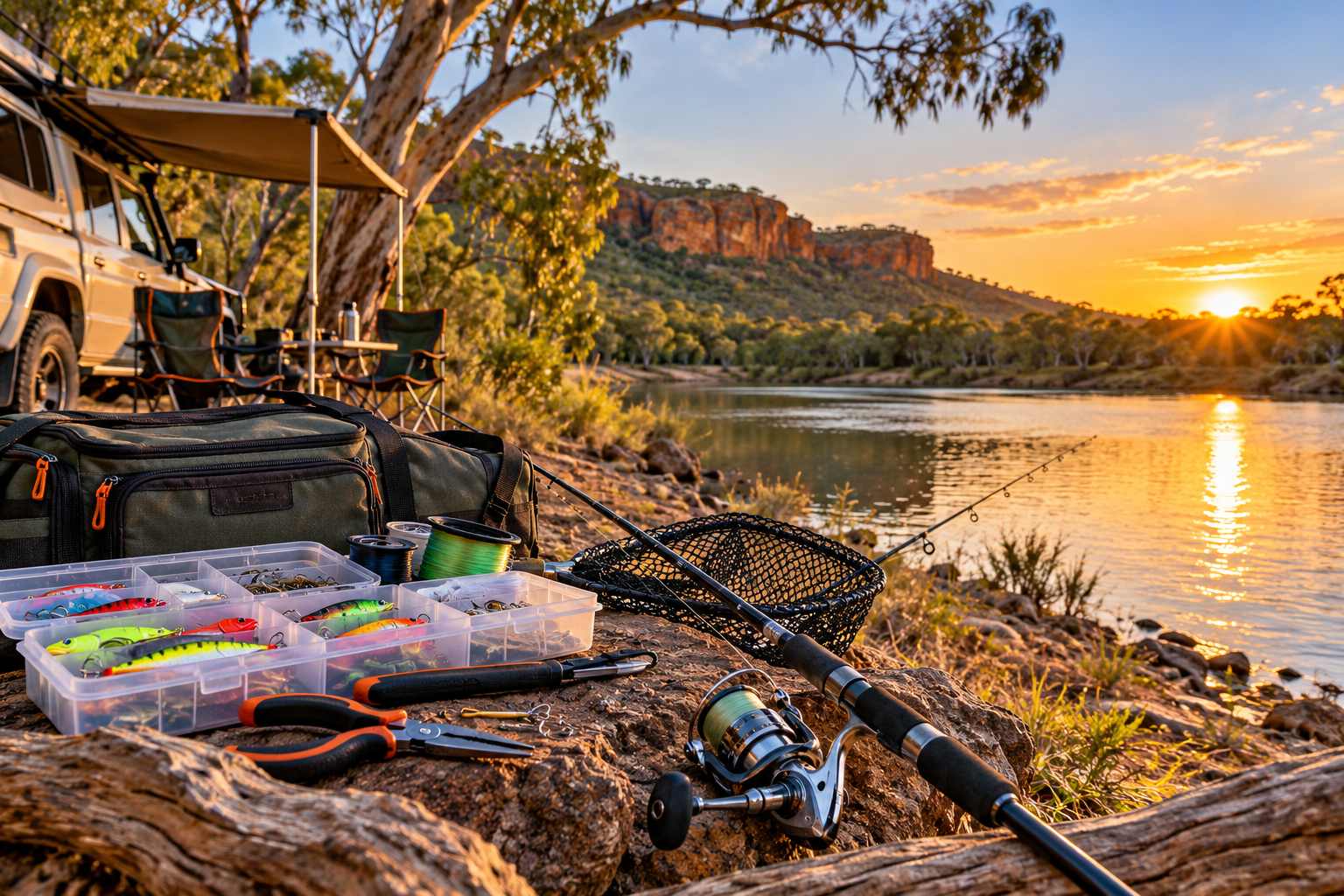
Tackle storage for travelling: A compact soft plastic wallet and a small hard tackle box or tray system is the most practical storage solution for a travelling angler. Keep your terminal tackle (hooks, sinkers, swivels, leaders) in a small waterproof zip-lock bag or a compact tackle tray, and your lures in a soft plastic wallet and a small hard-body lure box. The entire setup should fit into a single medium-sized tackle bag that can be stored in a 4WD drawer or caravan cupboard.
Tackle Storage for Travelling Anglers
Good tackle storage is one of the most overlooked aspects of fishing for travelling anglers. When you are packing a 4WD, caravan or camper trailer, space is at a premium — and a disorganised tackle collection quickly becomes a frustrating tangle of hooks, lures and loose line.
Tackle boxes: A hard-shell tackle box with removable divider trays is the traditional choice for storing terminal tackle — hooks, sinkers, swivels, leaders and small lures. Look for a compact, waterproof or water-resistant model with secure latches. Plano and Flambeau produce well-regarded tackle boxes that are widely available in Australia. A single medium-sized box with two or three removable trays is sufficient for most travelling anglers.
Soft tackle bags: A soft tackle bag with multiple pockets and removable inner trays is a versatile all-in-one storage solution. It can hold a tackle box, reel, line spools, accessories and snacks in one bag that is easy to carry to the water. Look for a bag with a waterproof base, reinforced handles and shoulder strap. Plano, Shimano and Daiwa all produce quality soft tackle bags suited to Australian conditions.
Waterproof lure trays: Dedicated waterproof lure trays — such as the Plano Waterproof StowAway series — are excellent for storing hard-body lures and soft plastics. The waterproof seal keeps moisture out and prevents rust on treble hooks. Stackable trays can be organised by lure type or species target and stored inside a larger tackle bag.
Soft plastic wallets: A soft plastic wallet or folder is the most compact way to store soft plastic lures. Packets of soft plastics can be stored in individual pockets, keeping them organised and preventing them from sticking together or drying out. A wallet holding 10–15 packets of soft plastics takes up very little space in a 4WD drawer or caravan cupboard.
Packing for a 4WD or caravan: The goal is to consolidate your fishing gear into one or two bags or boxes that can be stored in a single drawer or cupboard. Keep your rod and reel in a hard carry tube or rod sock to protect it during travel. Store your tackle bag alongside it. When you arrive at a fishing spot, you can grab both items and be fishing within minutes — without unpacking half the vehicle.
Useful Fishing Accessories
A few well-chosen accessories make fishing more practical, comfortable and enjoyable for travelling anglers. None of these items take up much space, but each one earns its place on a camping or touring trip.
Fishing pliers: A quality pair of fishing pliers is one of the most useful tools you can carry. They are used for removing hooks from fish (especially important for catch-and-release), cutting braid and monofilament, crimping leaders, and handling lures safely. Look for a pair with a built-in line cutter, corrosion-resistant construction (stainless steel or aluminium), and a lanyard attachment point. Rapala, Berkley and Mustad all produce reliable fishing pliers at reasonable prices.
Line cutters: A dedicated line cutter or braid scissors makes cutting braided line much easier than using standard scissors or a knife. Braid is notoriously difficult to cut cleanly with standard blades. A small pair of braid scissors or a dedicated line cutter clips onto a tackle bag or vest and is always within reach.
Landing nets: A compact folding or telescopic landing net is useful for landing larger fish cleanly, particularly when fishing from a bank or rock platform where you cannot easily beach the fish. Rubber mesh nets are gentler on fish scales and fins than nylon mesh, which is important for catch-and-release fishing. Look for a net with a folding or collapsible handle that packs flat for storage.
Rod holders: A portable rod holder — either a bank stick style that pushes into soft ground or a sand spike for beach fishing — allows you to set a rod down safely while waiting for a bite. This is particularly useful for bait fishing where you may be tending multiple rods. Compact bank sticks and sand spikes are inexpensive and take up very little space.
Fish measuring mats: A compact fish measuring mat or ruler allows you to quickly measure fish against legal size limits before deciding whether to keep or release them. Many Australian states have strict minimum size limits for popular species — a measuring mat removes any guesswork. Fold-flat measuring mats are available from most tackle shops and fit easily into a tackle bag.
Polarised sunglasses: A quality pair of polarised sunglasses is one of the most valuable items a fishing angler can own. Polarised lenses cut surface glare from the water, allowing you to see into the water to spot fish, structure and depth changes. They also protect your eyes from UV radiation and from errant hooks and lures. Look for lenses in amber, copper or brown tints for freshwater and estuary fishing, or grey for bright offshore conditions.
Headlamps: A compact headlamp is essential for early morning or evening fishing sessions, rigging up in low light, and navigating back to camp after dark. Look for a model with a red-light mode — red light preserves your night vision and is less likely to spook fish in shallow water. A headlamp with a rechargeable battery is more practical for extended trips than one that requires disposable batteries.
Small bait or fish coolers: A small soft-sided cooler or insulated bag is useful for keeping live bait fresh and for storing fish you intend to eat. A compact 5–10 litre soft cooler with a few ice bricks is sufficient for most day fishing sessions and takes up minimal space in a 4WD or caravan.
Fishing Safety
Fishing in the Australian outdoors is generally a safe and enjoyable activity, but like any outdoor pursuit it carries some risks. A few simple precautions make a significant difference, particularly when fishing in remote locations or unfamiliar environments.
Check weather and tides before you go: Weather conditions can change quickly in many parts of Australia, and tidal movements significantly affect fishing safety on beaches, rock platforms and estuaries. Check the Bureau of Meteorology forecast and local tide charts before heading out, and be prepared to change your plans if conditions deteriorate. Never fish from exposed rock platforms in rough or swell conditions.
Wear suitable footwear: Slippery rocks, wet riverbanks, oyster-covered platforms and soft sand all present different footing challenges. Wear closed-toe shoes or boots with good grip when fishing around rocks, riverbanks and beaches. Thongs and bare feet are not appropriate footwear for fishing in anything other than calm, flat conditions.
Handle hooks, knives and sharp tackle carefully: Hooks are sharp and can cause serious puncture wounds, particularly treble hooks on lures. Always use pliers to remove hooks from fish rather than your fingers. Store hooks in closed containers rather than loose in a bag. Handle filleting knives with care and store them in a sheath when not in use.
Wear a lifejacket where required: In many Australian states and territories, wearing a lifejacket is mandatory when fishing from certain vessels, kayaks, canoes and stand-up paddleboards. Even where it is not mandatory, wearing a lifejacket when fishing from a kayak, small boat or unstable platform is strongly recommended. Check the relevant state or territory maritime authority requirements before you launch.
Carry drinking water and sun protection: Dehydration and sunburn are genuine risks when fishing in the Australian sun, particularly in summer and in northern Australia. Carry more water than you think you will need, wear a broad-brimmed hat and long-sleeved shirt, and apply SPF 50+ sunscreen to all exposed skin. Reapply sunscreen every two hours, or more frequently if you are sweating or in and out of the water.
Tell someone where you are going: When fishing in remote locations — particularly in the outback, on remote beaches or in areas with no mobile phone coverage — always tell a responsible person where you are going, which tracks or access points you are using, and when you expect to return. Consider carrying a PLB (Personal Locator Beacon) or satellite communicator for remote fishing trips.
Know the rules: Fishing regulations in Australia vary significantly between states and territories, and between freshwater and saltwater environments. Before you fish, check the current rules for the area you are visiting, including minimum size limits, possession limits, closed seasons, gear restrictions and any area-specific rules. Regulations are enforced and penalties for breaches can be significant. The relevant state or territory fisheries authority website is the authoritative source for current rules.
Travel Rod Types Compared
| Rod Type | Packed Length | Performance | Best For | Price Range |
|---|---|---|---|---|
| 4-piece travel rod | 50–70cm per section | Close to one-piece | Serious anglers, lure fishing | $80–$300+ |
| 5–6 piece travel rod | 40–55cm per section | Very good | Backpacking, hiking anglers | $60–$250 |
| Telescopic rod | 40–55cm collapsed | Good for bait/light lures | Casual fishing, kids, backup rod | $30–$150 |
| Standard 1-piece rod | Full length (180–240cm) | Best performance | Base camp, boat, fixed location | $60–$400+ |
Affiliate Disclosure: Country Heart Outdoors participates in affiliate programs. If you purchase through our links, we may earn a commission at no extra cost to you. This helps support our free buying guides.