Best Drones for Australian Camping & Travel — 2026
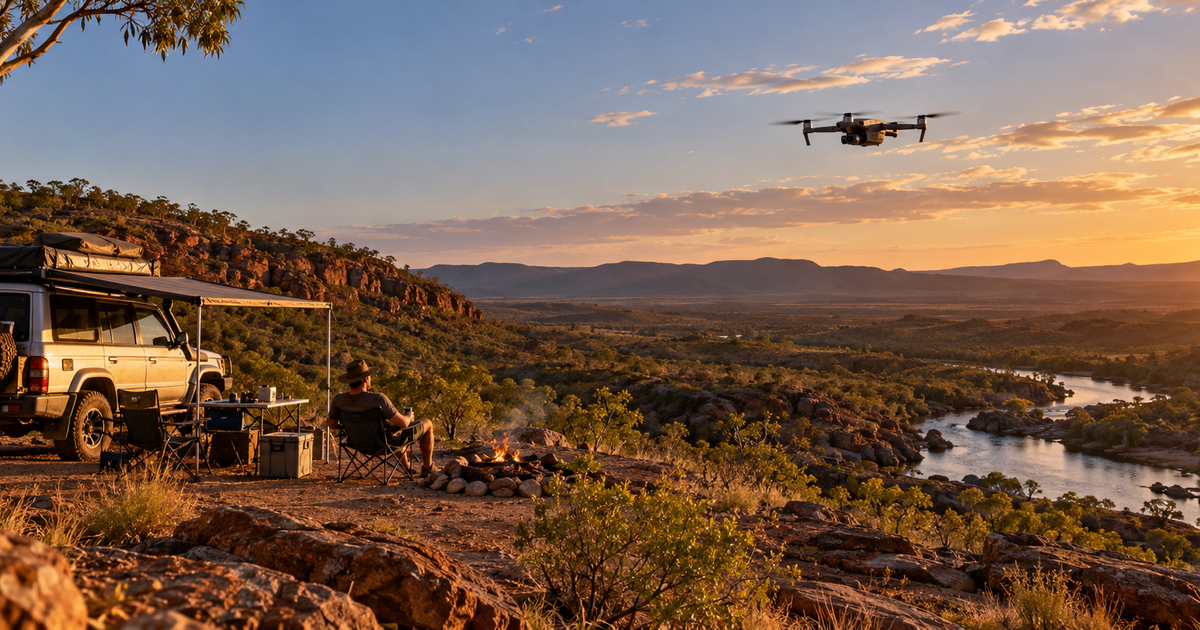
A compact drone has become a popular piece of kit for Australian campers and 4WD tourers. Whether you're capturing a sunrise over the Kimberley, filming your convoy crossing a creek, or documenting a coastal campsite from above, a modern sub-250g drone delivers cinematic footage that a phone camera simply cannot match. This guide compares the leading options for 2026 — with a focus on what actually matters in the field: camera quality, battery life, wind resistance, portability and Australian support.
Affiliate disclosure: We may earn a commission if you purchase through our links, at no extra cost to you. Learn more.
Why Drones Are Useful for Camping and 4WD Travel
The practical value of a drone on a camping or touring trip goes well beyond social media content. From a practical standpoint, a drone lets you scout a campsite from above before committing to a track, check a river crossing ahead, or locate a suitable spot to set up camp in unfamiliar terrain. From a creative standpoint, aerial footage transforms a trip journal into something genuinely cinematic — the scale of the Australian landscape is almost impossible to convey from ground level.
For 4WD tourers, a drone is also a useful tool for documenting the trip itself. Footage of your vehicle on a remote track, crossing a creek or navigating a rocky descent is far more compelling from 30 metres above than from a GoPro mounted to the bullbar. For fishing trips, a drone can help locate bait schools, identify reef structure in clear water, or simply capture the scenery of a remote estuary.
The key is choosing a drone that is genuinely portable — one that fits in your kit without taking up a dedicated case — and that performs reliably in Australian conditions, including wind, heat and dust.
Australian Drone Regulations: What You Need to Know
Before flying any drone in Australia, you must understand the rules set by the Civil Aviation Safety Authority (CASA). The rules differ depending on whether you are flying recreationally or for work or business purposes, and they apply regardless of the drone's weight.
Key rules for recreational flyers (Standard Operating Conditions):
Fly only during daylight hours. You must be able to see your drone at all times — you cannot fly beyond visual line of sight (BVLOS) without a specific CASA authorisation. Fly no higher than 120 metres above ground level. Check current CASA rules and a CASA-verified drone safety app before flying near controlled aerodromes — restrictions vary by drone weight and location. Do not fly over or near people who are not directly involved in the flight. Do not fly over a populous area. Do not fly in a way that creates a hazard to other aircraft, people or property.
Registration and accreditation: Recreational operators of drones under 250g do not need to register the drone or obtain an operator accreditation — provided they follow the standard operating conditions above. However, this exemption does not mean sub-250g drones are exempt from all rules. All standard operating conditions still apply.
Business and commercial use: If you use a drone for work or business purposes — including content creation for a business, real estate photography, or any paid work — different rules apply. You must register the drone with CASA regardless of its weight. Depending on the type of operation, you may also need to hold an operator accreditation (for eligible micro drones up to 250g and excluded-category drones up to 2 kg operating under standard conditions) or obtain a Remote Pilot Licence (RePL) and operate under a Remotely Piloted Aircraft Operator's Certificate (ReOC) for more complex operations. The specific requirements depend on the drone's weight, the nature of the operation, and whether you are operating under standard or non-standard conditions. Always check the current CASA requirements at casa.gov.au/drones before conducting any commercial or business drone operation.
National parks and protected areas: Many national parks, marine parks and conservation areas have their own restrictions on drone use that are separate from CASA rules. Some prohibit drone use entirely to protect wildlife. Always check with the relevant land management authority before flying in a national park or protected area. Do not assume that CASA compliance means you are permitted to fly in a specific location.
Private property: You must not fly over private property without the landowner's permission.
Always check the current regulations at casa.gov.au/drones before flying, as rules can change. CASA also provides a free app — a CASA-verified drone safety app? — that shows restricted airspace and no-fly zones on a map.
DJI Mini 4 Pro
The DJI Mini 4 Pro remains one of the most capable sub-250g drones available in Australia in 2026. Its 1/1.3-inch CMOS sensor with an f/1.7 aperture delivers genuinely impressive image quality — particularly in low light, which is where smaller sensors typically struggle. The drone shoots 4K/60fps video and supports D-Log M colour profile for post-production flexibility.
For camping and touring use, the Mini 4 Pro's omnidirectional obstacle sensing is a significant practical advantage. Flying in unfamiliar terrain — around trees, near cliff edges, over water — is considerably safer with obstacle avoidance than without it. The 34-minute flight time (with the standard Intelligent Flight Battery) is competitive for this class, and the RC 2 controller with its built-in screen eliminates the need to mount a phone.
Wind resistance is rated at Level 5 (38–49 km/h), which is adequate for most Australian conditions but not exceptional. In coastal areas or exposed ridgelines, you will encounter conditions that exceed this rating — plan flights for calmer periods of the day (typically early morning).
The Mini 4 Pro is available in Australia through DJI's Australian store and major retailers. DJI provides Australian warranty support. The Fly More Combo (which includes two additional batteries and a charging hub) is strongly recommended for touring use — three batteries gives you approximately 100 minutes of flight time, which is enough for a full morning's shooting.
Recreational operators do not need to register the Mini 4 Pro with CASA due to its sub-250g weight, provided they follow standard operating conditions. Commercial or business use requires registration and a RePL regardless of weight.
DJI Mini 5 Pro
The DJI Mini 5 Pro is DJI's latest sub-250g flagship, announced in 2025 and available in Australia in 2026. It features a larger 1-inch CMOS sensor — a significant step up from the Mini 4 Pro's 1/1.3-inch sensor — delivering noticeably better dynamic range and low-light performance. Video capabilities extend to 4K/120fps for slow-motion footage, with standard 4K recording and D-Log M colour profile support for post-production flexibility.
The Mini 5 Pro's maximum wind resistance is rated at 12 m/s (approximately 43 km/h), which is a meaningful real-world improvement for coastal and exposed-ridge flying compared to the Mini 4 Pro. The obstacle avoidance system is omnidirectional, and the drone weighs approximately 249g — keeping it under the 250g threshold for recreational CASA registration exemption.
For Australian camping and touring use, the Mini 5 Pro's 1-inch sensor is the headline upgrade. In the golden-hour and blue-hour light that makes Australian landscape photography so compelling, the larger sensor captures significantly more detail and handles high-contrast scenes better than smaller sensors. Flight time is rated at approximately 36 minutes with the standard battery.
The Mini 5 Pro is available through DJI's Australian store and authorised Australian retailers with local warranty support. As with all DJI Mini series drones, recreational operators do not need to register with CASA for recreational use, but all standard operating conditions apply. Business or work use requires registration and the appropriate CASA authorisation — see the regulations section above.
Note: Verify current pricing, availability and full specifications at store.dji.com/au before purchasing, as specifications and pricing can change after publication.
DJI Flip
The DJI Flip is a distinctive entry in DJI's 2025–2026 lineup — a sub-249g foldable drone with integrated propeller guards that make it genuinely safer to fly around people and in confined spaces. The propeller guards are not removable, which means the Flip is slightly larger than a bare-frame drone of equivalent size, but the safety benefit is real: the guards significantly reduce the risk of injury from accidental contact with the propellers.
The Flip's camera uses a 1/1.3-inch CMOS sensor with an f/1.7 aperture, shooting up to 4K/100fps slow-motion video. This is a step down from the Mini 4 Pro and Mini 5 Pro in terms of sensor size and video capability, but the image quality is still excellent for social media and travel documentation. The Flip is primarily positioned as a beginner and casual-use drone rather than a professional imaging tool.
Flight time is rated at approximately 31 minutes. Wind resistance is Level 5 (38–49 km/h). Obstacle sensing is forward and backward only — not omnidirectional like the Mini 4 Pro and Mini 5 Pro.
For camping and touring use, the Flip's propeller guards make it a good choice for anyone who wants to fly near their campsite, around vehicles, or in situations where other people are present. The guards also provide some protection for the propellers during transport — a practical benefit when packing a drone in a touring kit.
The DJI Flip is available in Australia through DJI's Australian store and authorised retailers with local warranty support. Recreational operators do not need to register it with CASA due to its sub-249g weight, provided they follow standard operating conditions. Business or work use requires registration and the appropriate CASA authorisation regardless of the drone's weight.
Other Options Worth Considering
Beyond the DJI Mini series and Flip, a few other drones are worth considering for Australian camping and touring use.
Autel EVO Nano+: The Autel EVO Nano+ is a 249g drone with a 50MP 1/1.28-inch CMOS sensor — competitive with the DJI Mini 4 Pro on paper. Autel is a legitimate DJI alternative with Australian distribution, though the ecosystem (accessories, spare batteries, software) is less mature than DJI's. Wind resistance is Level 5. Obstacle sensing is three-directional (forward, backward, downward). For photographers who want an alternative to DJI, the Nano+ is worth evaluating.
DJI Air 3 (above 250g): If sub-250g weight is not a priority and you want a step up in camera capability, the DJI Air 3 is worth considering. It weighs 720g and requires CASA registration for recreational use, along with operator accreditation. Its dual-camera system (wide + medium telephoto) and 46-minute flight time are genuinely superior to any sub-250g option. For serious landscape and travel photography, the Air 3's image quality is noticeably better.
For most campers and tourers who want a drone that fits in their kit without dedicated luggage, stays under 250g for simplified CASA compliance, and delivers excellent video quality, the DJI Mini 4 Pro or Mini 5 Pro remain the strongest all-round choices in 2026.
Battery Management Off-Grid
Battery management is one of the most important practical considerations for drone use on a camping or touring trip. Each DJI Mini series battery holds approximately 2,445 mAh and takes around 60–80 minutes to charge from a standard USB-C source. On a remote trip without mains power, you need a plan for keeping batteries charged.
The most practical approach is to charge drone batteries from your 12V system using a USB-C power bank or directly from a 12V-to-USB-C adapter. DJI's two-way charging hub for the Mini series allows you to charge multiple batteries sequentially from a single USB-C source, which is convenient when running off a portable power station or solar setup.
A 100Wh portable power station (such as an EcoFlow River 2 or similar) can charge three Mini series batteries from flat — enough for approximately 90–100 minutes of flight time. A 200W solar panel in good Australian sun can recharge a 100Wh power station in 1–2 hours, making a solar-plus-power-station setup a practical off-grid charging solution for multi-day trips.
Practical tips: Always store LiPo batteries at storage charge (approximately 50–60%) if not flying for more than a few days. Do not leave batteries in a hot vehicle — heat degrades LiPo cells rapidly. Carry batteries in a fireproof LiPo bag as a precaution. Allow batteries to cool to ambient temperature before charging after a flight.
Portability, Transport and Dust Protection
The DJI Mini series folds to approximately the size of a large smartphone, making it genuinely packable in a touring kit. The standard DJI shoulder bag is adequate for day trips, but for serious 4WD touring on corrugated roads, a hard-shell case is strongly recommended. Vibration and shock from corrugated roads can damage gimbal components over time if the drone is not properly protected.
Dust is a significant concern in Australian outback conditions. The DJI Mini 4 Pro and Mini 5 Pro are not rated for dust resistance — fine red dust can infiltrate the gimbal and motor housings if the drone is used in dusty conditions without precautions. Practical measures include: keeping the drone in its case when not in use, avoiding flying in dusty conditions (particularly behind vehicles on dirt roads), and using a soft brush to clean the gimbal and motor housings after flying in dusty environments.
Saltwater exposure is a serious risk for coastal use. Salt spray can corrode motor windings and electronic components. After flying in coastal conditions, wipe down the drone with a slightly damp cloth and allow it to dry thoroughly before storing. Do not fly directly over breaking surf or in heavy sea spray.
For serious touring, consider carrying a small cleaning kit: a soft brush, a microfibre cloth, and cleaning tools as recommended by the manufacturer for clearing dust from motor housings.
Drone Comparison: DJI Mini 4 Pro vs Mini 5 Pro vs DJI Flip
| Spec | DJI Mini 4 Pro | DJI Mini 5 Pro | DJI Flip |
|---|---|---|---|
| Weight | 249g | 249g | 249g |
| Sensor | 1/1.3-inch CMOS | 1-inch CMOS | 1/2-inch CMOS |
| Aperture | f/1.7 | Not published | f/1.7 |
| Max video | 4K/60fps | 4K/120fps | 4K/30fps |
| Flight time | 34 min | ~36 min | 31 min |
| Wind resistance | Level 5 (38–49 km/h) | 12 m/s (~43 km/h) | Level 5 (38–49 km/h) |
| Obstacle sensing | Omnidirectional | Omnidirectional | Forward & backward |
| Propeller guards | Optional | Optional | Integrated (fixed) |
| CASA registration (recreational) | Not required (<250g) | Not required (<250g) | Not required (<249g) |
| Best for | All-round touring & photography | Demanding conditions & video | Beginners & confined spaces |
Product Reviews & Prices
View products and check current Australian pricing.
DJI Mini 4 Pro
Omnidirectional obstacle avoidance, 1/1.3-inch sensor and 34-minute flight time in a 249g package. The strongest all-round choice for Australian camping and touring.
Pros
- ✓Omnidirectional obstacle sensing
- ✓Excellent 1/1.3-inch sensor
- ✓34-minute flight time
- ✓Sub-250g — no CASA registration for recreational use
Cons
- –Premium price for a mini drone
- –Business/work use requires CASA registration regardless of weight
Check Price
DJI Mini 5 Pro
1-inch CMOS sensor, 4K/120fps slow motion and 12 m/s wind resistance in a sub-250g airframe. The upgrade choice for serious landscape photography and coastal flying.
Pros
- ✓1-inch CMOS sensor — best image quality in the sub-250g class
- ✓4K/120fps slow-motion video
- ✓12 m/s wind resistance — better for coastal and exposed locations
- ✓Sub-250g — no CASA registration for recreational use
Cons
- –Higher price than Mini 4 Pro
- –Business/work use requires CASA registration regardless of weight
Check Price
DJI Flip
Integrated propeller guards and sub-249g weight make the Flip the safest option for flying near people and in tight spaces around camp.
Pros
- ✓Integrated propeller guards for safer flying
- ✓Sub-249g — no CASA registration for recreational use
- ✓Good 4K/30fps camera for travel documentation
Cons
- –Smaller 1/1.3-inch sensor than Mini 4 Pro / Mini 5 Pro
- –Forward and backward obstacle sensing only (not omnidirectional)
- –Propeller guards not removable
Check Price
Affiliate Disclosure: Country Heart Outdoors participates in affiliate programs. If you purchase through our links, we may earn a commission at no extra cost to you. This helps support our free buying guides.