Best Drones for 4WD Touring, Fishing & Outdoor Photography — 2026
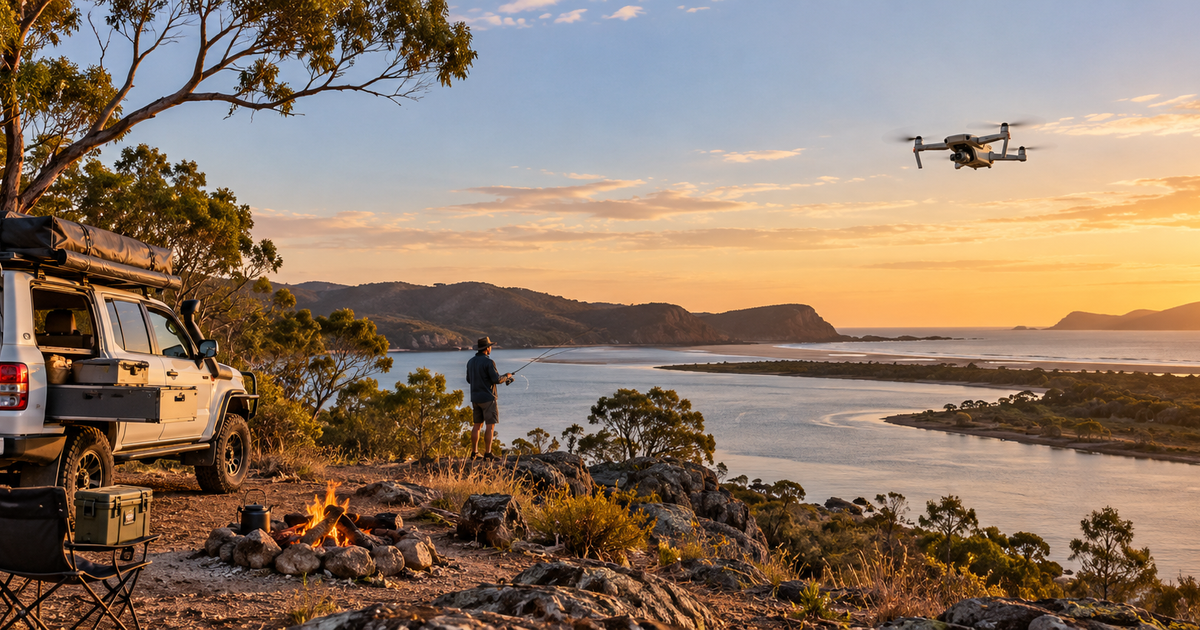
A compact drone is one of the most versatile pieces of kit you can carry on a 4WD touring or fishing trip. Whether you're documenting a remote campsite in the Kimberley, photographing a coastal estuary from above, or capturing your convoy on a corrugated outback track, modern drones deliver footage that no ground-level camera can match. This guide covers the best drones for Australian 4WD touring, fishing and outdoor photography in 2026 — with practical advice on carrying, charging, protecting and flying your drone in the field.
Affiliate disclosure: We may earn a commission if you purchase through our links, at no extra cost to you. Learn more.
Choosing a Drone for 4WD Touring
The most important factor when choosing a drone for 4WD touring is portability. On a long trip, every kilogram and every litre of storage space matters. A drone that requires a dedicated hard case, a separate controller bag and a bulky charging setup will quickly become a burden — and may get left behind on shorter day trips where you most want it.
For most 4WD tourers, a sub-250g drone in the DJI Mini series is the right choice. The Mini 5 Pro and Mini 4 Pro both fold to a compact form factor that fits in a jacket pocket or a small pouch in your pack. The DJI Air 3S is a larger, heavier drone with a superior camera — it is worth considering if photography quality is your primary goal and you are willing to carry the extra weight and bulk.
Key considerations for touring use:
Storage: A folded DJI Mini 5 Pro or Mini 4 Pro fits in a small padded pouch. The DJI Air 3S requires a larger case. Both should be stored in a dust-proof container when travelling on dirt roads — fine outback dust will find its way into any unsealed bag.
Dust protection: Australian outback travel generates significant fine dust. Store your drone in a sealed case or dry bag when not in use. Avoid flying in dusty conditions — dust ingested by the motors will shorten their lifespan. After a dusty day's travel, inspect the motors and vents before flying.
Heat management: Australian summer temperatures can exceed 40°C in the outback. Drone batteries lose capacity in extreme heat and should not be left in direct sunlight or in a hot vehicle. Store batteries in a cool, shaded location. Allow the drone to cool before flying if it has been sitting in a hot vehicle. Most DJI drones will display a battery temperature warning if the battery is too hot to fly safely.
Vibration: Corrugated dirt roads are hard on electronics. Store your drone in a padded case and avoid leaving it loose in the vehicle. Check that the gimbal is undamaged before each flight — corrugated roads can cause gimbal drift or damage if the drone is not properly secured.
Charging Drone Batteries from 12V and Portable Power
On a remote touring trip, mains power is not available. Charging drone batteries requires either a portable power station, a 12V DC charger, or a solar setup with sufficient capacity.
Portable power stations: A portable power station with a 240V AC inverter output (such as an EcoFlow, Jackery or similar) can charge DJI batteries using the standard AC charger supplied with the drone. This is the most convenient option — the same power station that charges your phone, laptop and camera batteries can charge your drone. Ensure the power station has sufficient capacity for your trip. DJI Intelligent Flight Batteries for the Mini series are typically 2,250–2,590 mAh at 7.38–7.7V. Charging three batteries from a 256Wh portable power station will consume a meaningful portion of its capacity.
12V DC charging: DJI offers 12V car chargers for most of their drone batteries. These can be powered directly from your vehicle's 12V system or from a 12V auxiliary battery. Charging via 12V is slower than AC charging but is a practical option when driving between campsites. Do not charge batteries while driving on rough corrugated roads — vibration and heat can affect the charging process.
Solar charging: A solar panel connected to a portable power station or 12V battery system can recharge drone batteries during the day. In full Australian sun, a 100–200W solar panel can typically recharge a portable power station sufficiently to charge a full set of drone batteries overnight. Factor drone charging into your overall power budget when planning a remote trip.
Battery storage: Do not store LiPo or LiHV drone batteries fully charged for extended periods — this degrades battery health. DJI Intelligent Flight Batteries have an auto-discharge function that reduces the charge to a storage level if the battery is not used within a set number of days. This is normal behaviour and not a fault. Store batteries at room temperature where possible — avoid leaving them in a hot vehicle.
Wind Limitations and Flying in Australian Conditions
Wind is the most significant practical limitation for drone flying in Australian outdoor conditions. All consumer drones have a maximum wind resistance rating — exceeding this rating risks losing control of the drone or triggering a forced landing in an unsuitable location.
DJI Mini 5 Pro: rated at 12 m/s (approximately 43 km/h). This is the highest wind resistance in the sub-250g class and makes the Mini 5 Pro a better choice for coastal and exposed locations than the Mini 4 Pro.
DJI Mini 4 Pro: rated at Level 5 (38–49 km/h). Competitive for its class, but coastal and ridgeline flying in moderate wind conditions can push against this limit.
DJI Air 3S: rated at 12 m/s (approximately 43 km/h). The Air 3S's larger airframe and more powerful motors give it better stability in gusty conditions compared to sub-250g drones at the same rated wind speed.
Practical advice:
Fly early in the morning. Wind speeds in the Australian outback and coastal areas are typically lowest in the first two hours after sunrise. This is also the best light for photography.
Check the forecast. The CASA a CASA-verified drone safety app shows wind conditions as well as airspace restrictions. Weather apps such as Windy or BOM provide detailed wind forecasts.
Do not fly in rain. Consumer drones are not waterproof. Even light rain can damage the motors, gimbal and electronics. If rain is forecast, do not fly.
Beach and coastal flying: Sand and salt spray are damaging to drone motors and electronics. Avoid flying in breaking surf conditions. After coastal flying, inspect the motors and gimbal for salt residue and wipe down the airframe with a dry cloth. Do not fly directly into sea spray.
DJI Mini 5 Pro — Best Sub-250g Touring Drone
The DJI Mini 5 Pro is DJI's current sub-250g flagship and the strongest choice for 4WD touring and outdoor photography in 2026. Its 1-inch CMOS sensor delivers a significant step up in image quality over the Mini 4 Pro — better dynamic range, improved low-light performance, and 4K/120fps slow-motion video capability.
For touring use, the Mini 5 Pro's key advantages are its combination of a large sensor, sub-250g weight, and 12 m/s wind resistance. The wind resistance rating is the highest in the sub-250g class, making it a more capable choice for coastal flying, exposed ridgelines and the gusty conditions common in the Australian outback.
The Mini 5 Pro supports 4K/60fps HDR video and 4K/120fps slow motion, along with D-Log M colour profile for post-production flexibility. Still photography is supported at up to 48MP. Omnidirectional obstacle sensing is included — a practical safety feature when flying in unfamiliar terrain around trees, cliffs and other obstacles.
For recreational operators, the Mini 5 Pro's sub-250g weight means no CASA registration is required, provided standard operating conditions are followed. Business or work use requires registration regardless of weight.
The DJI Mini 5 Pro is available in Australia through DJI's Australian store (store.dji.com/au) and authorised Australian retailers. Verify current pricing and availability before purchasing — prices and stock levels vary by retailer and configuration.
DJI Air 3S — Best for Photography Quality
The DJI Air 3S is DJI's mid-range drone and the strongest choice for photographers who prioritise image quality over minimum weight. It features a 1-inch CMOS main camera — the same sensor size as the Mini 5 Pro — paired with a secondary telephoto camera, giving it a dual-camera system that no sub-250g drone can match.
The telephoto camera allows you to capture compressed perspective shots and bring distant subjects closer without physically moving the drone. For landscape photography, this opens up compositional options that a single-camera drone cannot achieve. The Air 3S supports 4K/60fps HDR on both cameras, 4K/120fps slow motion, and a maximum stated flight time of up to 45 minutes — significantly longer than any sub-250g drone.
Wind resistance is rated at 12 m/s (approximately 43 km/h), matching the Mini 5 Pro despite the Air 3S's larger airframe. Omnidirectional obstacle sensing is included.
The trade-off is size and weight. The Air 3S is heavier and larger than the Mini series — it does not fit in a jacket pocket and requires a dedicated case for transport. For a 4WD touring setup where storage space is at a premium, this is a meaningful consideration. The Air 3S is the right choice if photography is your primary goal and you have the space and willingness to carry a larger drone.
The Air 3S is available in Australia through DJI's Australian store (store.dji.com/au) and authorised Australian retailers. Verify current pricing and availability before purchasing.
DJI Mini 4 Pro — Lighter and More Affordable Alternative
The DJI Mini 4 Pro remains a strong choice for 4WD touring in 2026, particularly for buyers who want a capable drone at a lower price point than the Mini 5 Pro. Its 1/1.3-inch CMOS sensor with f/1.7 aperture delivers good image quality — not as strong as the 1-inch sensors in the Mini 5 Pro and Air 3S, but competitive for travel documentation and social media content.
The Mini 4 Pro shoots 4K/60fps video, supports D-Log M colour profile, and includes omnidirectional obstacle sensing. Its 34-minute flight time (standard battery) is competitive for the sub-250g class. Wind resistance is rated at Level 5 (38–49 km/h).
For buyers who are new to drone photography, or who want a capable touring drone without the higher cost of the Mini 5 Pro, the Mini 4 Pro is a practical choice. It is available in Australia through DJI's Australian store and major retailers, and DJI provides Australian warranty support.
The Fly More Combo — which includes two additional batteries and a charging hub — is strongly recommended for touring use. Three batteries provides approximately 100 minutes of flight time, which is sufficient for a full morning's shooting session.
Drone Photography for Fishing Trips
Drones are increasingly used on Australian fishing trips for aerial photography and scouting. However, the rules around drone use in fishing contexts are not straightforward, and it is important to understand what is and is not permitted before flying.
CASA rules apply everywhere. All standard operating conditions apply on fishing trips — including the requirement to keep the drone within visual line of sight, not to fly over people, and not to fly in restricted airspace. Fishing locations near airports, in national parks, or in marine parks may have additional restrictions. Always check the CASA a CASA-verified drone safety app and the relevant land or marine park authority before flying.
State and territory fishing regulations vary. Some Australian states and territories have specific rules about the use of drones in connection with fishing. These rules differ between jurisdictions and can change. Do not assume that what is permitted in one state is permitted in another. Check the current regulations with the relevant state or territory fisheries authority before using a drone in connection with fishing.
Photography and scouting from a lawful location. Using a drone to photograph a river, estuary or coastal area from a lawful flying location — for example, to document the scenery, capture the landscape, or photograph your boat from above — is a straightforward recreational use of a drone, subject to the standard CASA rules and any local restrictions.
Saltwater and boat use: Flying a drone from a boat introduces additional considerations. The boat must be stationary or moving slowly. Salt spray is damaging to drone electronics — avoid flying in conditions where spray is likely to reach the drone. After flying near saltwater, wipe down the airframe and inspect the motors for salt residue. Store the drone in a sealed, dry case when not in use on the water.
Spare Batteries and Field Storage
Battery management is one of the most important practical aspects of drone use on a remote touring trip. A single battery gives you 18–45 minutes of flight time depending on the drone model and conditions. For a full day of photography, you will need at least three batteries — and ideally four or five for extended remote trips where charging opportunities are limited.
DJI Fly More Combos include two additional batteries and a multi-battery charging hub. The charging hub charges batteries sequentially from a single power source, which is more practical than charging individual batteries one at a time from a portable power station.
Battery transport: Drone batteries (LiPo and LiHV chemistry) are classified as dangerous goods for air travel. If you are flying to a remote location and then driving, check the current airline rules for carrying drone batteries in carry-on luggage. Most airlines permit a limited number of batteries in carry-on but prohibit them in checked luggage. Verify the current rules with your airline before travelling.
Storage temperature: Do not store drone batteries in a hot vehicle. Temperatures above 40°C can permanently reduce battery capacity and, in extreme cases, cause thermal runaway. Store batteries in a cool, shaded location — a cooler bag or an insulated case is a practical solution in Australian summer conditions.
Pre-flight checks: Before each flight, check that all batteries are charged, the gimbal is undamaged, the propellers are undamaged and correctly seated, and the memory card is inserted and has sufficient space. A pre-flight checklist takes two minutes and prevents the most common causes of a wasted flight.
Australian Drone Regulations
All drone flying in Australia is regulated by the Civil Aviation Safety Authority (CASA). The rules apply to all drones regardless of weight, including drones under 250g.
Key rules for recreational flyers:
All drones must follow CASA's standard operating conditions. Flying under 250g does not exempt a drone from these rules — it only affects registration requirements for recreational use.
Recreational flying does not currently require registration or operator accreditation for drones under 250g, provided standard operating conditions are followed.
Business or work use requires CASA registration plus the appropriate accreditation or licensing arrangements, regardless of the drone's weight.
Keep the drone within visual line of sight at all times, unless specifically authorised otherwise by CASA.
Check a CASA-verified drone safety app — such as the CASA a CASA-verified drone safety app — before every flight to confirm airspace restrictions and no-fly zones at your location.
Additional restrictions may apply in national parks, wildlife areas, marine parks and other managed land. Always check with the relevant land management authority before flying in these areas.
The official CASA reference for drone rules is casa.gov.au/drones/drone-rules/drone-safety-rules. Rules can change — always check the current regulations before flying.
4WD Touring Drone Comparison: Mini 5 Pro vs Mini 4 Pro vs Air 3S
| Feature | DJI Mini 5 Pro | DJI Mini 4 Pro | DJI Air 3S |
|---|---|---|---|
| Weight | Sub-250g | Sub-250g | Heavier (not sub-250g) |
| Main sensor | 1-inch CMOS | 1/1.3-inch CMOS | 1-inch CMOS |
| Secondary camera | None | None | Telephoto |
| Max video | 4K/120fps | 4K/60fps | 4K/120fps |
| Stated max flight time | Check DJI AU | 34 min | Up to 45 min |
| Wind resistance | 12 m/s (~43 km/h) | Level 5 (~38–49 km/h) | 12 m/s (~43 km/h) |
| Obstacle sensing | Omnidirectional | Omnidirectional | Omnidirectional |
| CASA registration (recreational) | Not required | Not required | Required |
| Best for | Touring & coastal | Budget touring | Photography quality |
Product Reviews & Prices
View products and check current Australian pricing.
DJI Mini 5 Pro
1-inch CMOS sensor, 4K/120fps slow motion and 12 m/s wind resistance in a sub-250g airframe. The strongest choice for 4WD touring and coastal photography in 2026.
Pros
- ✓1-inch CMOS sensor — best image quality in the sub-250g class
- ✓4K/120fps slow-motion video
- ✓12 m/s wind resistance — better for coastal and exposed locations
- ✓Sub-250g — no CASA registration for recreational use
- ✓Omnidirectional obstacle sensing
Cons
- –Higher price than Mini 4 Pro
- –Business/work use requires CASA registration regardless of weight
- –Verify current pricing and availability at store.dji.com/au
Check Price
DJI Mini 4 Pro
1/1.3-inch CMOS sensor, omnidirectional obstacle sensing and 34-min flight time in a sub-250g airframe. A capable touring drone at a lower price point than the Mini 5 Pro.
Pros
- ✓Sub-250g — no CASA registration for recreational use
- ✓Omnidirectional obstacle sensing
- ✓34-minute flight time (standard battery)
- ✓Good 4K/60fps image quality for travel documentation
- ✓Lower price than Mini 5 Pro
Cons
- –Smaller 1/1.3-inch sensor than Mini 5 Pro and Air 3S
- –Business/work use requires CASA registration regardless of weight
Check Price
DJI Air 3S
Dual-camera system with 1-inch CMOS main sensor and telephoto camera, up to 45-minute flight time and 12 m/s wind resistance. The right choice when photography quality is the priority.
Pros
- ✓Dual-camera system — main 1-inch CMOS plus telephoto
- ✓Up to 45-minute stated maximum flight time
- ✓4K/120fps slow-motion video
- ✓12 m/s wind resistance
- ✓Omnidirectional obstacle sensing
Cons
- –Heavier and larger than sub-250g Mini series — requires dedicated case
- –CASA registration required for recreational use
- –Higher price than Mini series
Check Price
Affiliate Disclosure: Country Heart Outdoors participates in affiliate programs. If you purchase through our links, we may earn a commission at no extra cost to you. This helps support our free buying guides.