Best Composting Toilets for Off-Grid 2026
A composting toilet is one of the most practical upgrades you can make to a caravan, tiny home or off-grid property. They use no water, produce no black water waste, and — when maintained correctly — are completely odour-free. This guide compares the leading models available in Australia and explains everything you need to know before buying.
Affiliate disclosure: We may earn a commission if you purchase through our links, at no extra cost to you. Learn more.
How Does a Composting Toilet Work?
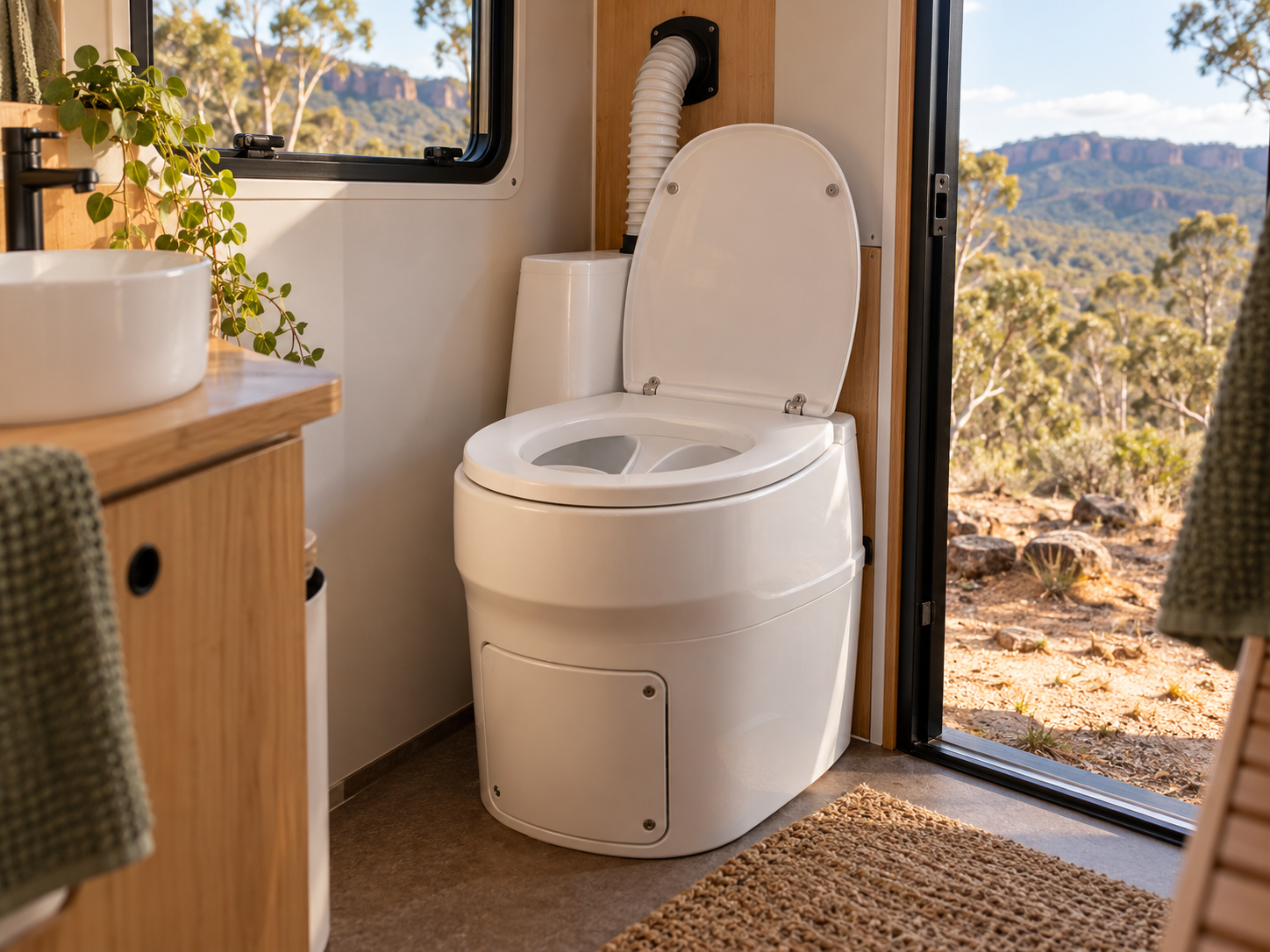
A composting toilet breaks down human waste through aerobic decomposition — the same natural process that turns garden waste into compost. The key to making this work without odour is separating liquid and solid waste. Liquids are diverted to a separate container or evaporated via a vent fan, while solids compost in the main chamber with a bulking agent such as coconut coir or peat moss. A small 12V fan draws air through the chamber and out a vent pipe, keeping the composting environment aerobic and eliminating odours at the source.
Urine Separation: Why It Matters
Urine diversion is the single most important feature of a modern composting toilet. When urine mixes with solid waste, it creates the anaerobic, ammonia-rich conditions that cause odour. By separating the two streams, the solid chamber stays dry enough to compost aerobically — which is odourless. The liquid container typically needs emptying every two to three days for two people. Most urine-diverting toilets include a clearly shaped diverter insert that makes correct use straightforward once you are familiar with the unit.
Ventilation Requirements
Many composting toilets include a 12V fan that runs continuously to draw air through the composting chamber — some systems use unpowered ventilation instead. Check the specifications of the model you are considering. and exhaust it outside via a vent pipe (typically 75mm diameter). This negative pressure inside the unit means any odour is drawn away from the user rather than into the living space. The fan draws very little power — usually 0.1 to 0.2A — making it suitable for solar and battery systems. Proper installation of the vent pipe with minimal bends is important for effective airflow. Most manufacturers recommend a vertical vent run where possible.
Capacity and Maintenance
The solid chamber in a urine-diverting composting toilet typically needs emptying every four to eight weeks for two people using the toilet full-time. The composted material should be disposed of according to your local council and state requirements — do not assume it can automatically be used in gardens or buried without checking local regulations for your area. The liquid container needs emptying every two to three days for two people. Maintenance involves adding a small amount of bulking agent (coconut coir or peat moss) after each solid use, and occasionally agitating the composting chamber with the built-in handle. The process is straightforward once established.
Suitability: Caravans, Tiny Homes and Off-Grid Properties
Composting toilets are well suited to caravans and motorhomes where eliminating the need for a cassette or black water tank is a significant practical advantage. For tiny homes and off-grid properties, they remove the need for a septic system entirely. The main considerations for caravans are physical dimensions (the toilet must fit your bathroom space), the 12V power requirement for the fan, and the vent pipe routing. For permanent installations, a larger-capacity unit may be preferable. All three models reviewed here are suitable for both mobile and fixed installations.
Best Composting Toilet for a Caravan — What to Look For
A composting toilet can be a practical option for caravans, camper trailers and off-grid touring, particularly when you want to reduce reliance on dump points or avoid carrying a traditional black-water tank.
For caravan use, the best composting toilet is not necessarily the largest or most expensive model. The right choice depends on the space available, how many people will use it and how often you travel.
When comparing caravan composting toilets, look at:
- Size and footprint: Measure the available bathroom space carefully, including room for sitting, cleaning and removing waste containers.
- Urine separation: Separating liquid and solid waste can help reduce odour and extend the time between emptying the solids container.
- Ventilation: Many composting toilets use a small ventilation fan. Check where the vent hose can be routed through the caravan safely and neatly.
- Power requirements: Some models require a small 12V supply for the ventilation fan, while others operate without power.
- Capacity: A couple travelling occasionally may need a different system from a family living in a caravan full-time.
- Ease of emptying: Consider how easily the liquid bottle and solids container can be removed without dismantling the bathroom.
- Replacement consumables: Check the availability and cost of composting medium, liners, filters and other replacement parts.
- Australian support: Buying a model with readily available spare parts and local support can make ownership much easier.
For occasional caravan travel, a compact urine-diverting composting toilet may be sufficient. For longer trips or full-time use, a larger system with better ventilation and easier servicing may be worth the extra space.
Always follow the manufacturer's instructions for use and disposal, and check any campground or local waste-disposal requirements that apply where you are travelling.
Frequently Asked Questions
Are composting toilets good for caravans?
Yes. They can work very well in caravans because they do not require a traditional black-water holding tank and can reduce dependence on dump points. The main considerations are available space, ventilation, capacity and how easily the unit can be emptied.
Do caravan composting toilets smell?
A correctly installed and maintained composting toilet should have minimal odour. Good urine separation, adequate ventilation and correct use of the recommended composting medium are important.
Do composting toilets need electricity?
Some models use a small 12V ventilation fan, while others are completely non-electric. Check the power requirements before choosing a model for your caravan.
What to Consider Before Buying
Before choosing a composting toilet, consider: the number of people using it full-time (this affects how often you empty it); your available 12V power (the fan runs continuously); your bathroom dimensions and the toilet's footprint; how you will route the vent pipe; and your local council and state requirements around waste disposal. Budget for the ongoing cost of coconut coir or peat moss as a bulking agent — a bag typically lasts one to two months for two people. If you are in a caravan, check that the toilet height works with your existing seat height or plan for a small platform.
Composting Toilet Comparison
| Model | Type | Capacity | Fan Power | Best For |
|---|---|---|---|---|
| Nature's Head | Urine-diverting | 4–6 weeks / 2 people | 12V (included) | Caravans & boats |
| OGO Origin | Urine-diverting | 3–5 weeks / 2 people | 12V (included) | Compact spaces |
| Air Head | Urine-diverting | 4–6 weeks / 2 people | 12V (included) | Tiny homes & off-grid |
Product Reviews & Prices
View products and check current Australian pricing.
Nature's Head Composting Toilet
Nature's Head is a widely used composting toilet in the world for off-grid caravans, tiny homes and boats. Its urine-diverting design, stainless steel hardware and 5-year warranty make it a strong long-term investment. The agitator handle mixes the composting medium effectively, and the unit is well regarded for being genuinely odour-free when maintained correctly.
Pros
- ✓World's most popular composting toilet
- ✓Stainless steel hardware throughout
- ✓5-year warranty
- ✓Genuine odour-free performance
- ✓Strong resale value
Cons
- –Liquid container needs emptying every 2–3 days
- –Learning curve for new users
- –Requires ongoing bulking agent (coir/peat)
OGO Origin Composting Toilet
The OGO Origin is a newer urine-diverting composting toilet designed with a smaller footprint than the Nature's Head, making it a good option for tighter caravan bathrooms. It features an electric agitator (rather than a manual handle), a larger liquid container than some competitors, and a modern aesthetic. It is made in the USA and has a growing user base in Australia.
Pros
- ✓Smaller footprint than Nature's Head
- ✓Electric agitator — no manual turning
- ✓Larger liquid container
- ✓Modern, clean design
- ✓Active and helpful manufacturer support
Cons
- –Newer product with a shorter track record
- –Electric agitator adds a small additional power draw
- –Less widely available in Australia
Air Head Composting Toilet
The Air Head is a well-established urine-diverting composting toilet popular with tiny home builders and off-grid property owners. It has a slightly larger solid chamber than the Nature's Head, which suits permanent or semi-permanent installations where emptying frequency matters. The design is straightforward and the unit has a strong reputation for reliability over many years of use.
Pros
- ✓Larger solid chamber capacity
- ✓Well suited to permanent installations
- ✓Long-established reputation for reliability
- ✓Simple, robust design
- ✓Good for higher-use situations
Cons
- –Larger footprint — may not suit all caravan bathrooms
- –Manual agitator only
- –Less compact than OGO
Affiliate Disclosure: Country Heart Outdoors participates in affiliate programs. If you purchase through our links, we may earn a commission at no extra cost to you. This helps support our free buying guides.