Battery & Rechargeable Camping Lights — Australian Buying Guide 2026
Reliable lighting is one of the most practical items in a camping kit. Whether you are setting up a tent after dark, cooking at a camp kitchen or navigating to the amenities block, a good camping light makes the task easier and safer. The range of battery and rechargeable camping lights available in Australia has expanded considerably, with USB-C rechargeable models now offering a practical alternative to disposable battery lights. This guide covers the main types of camping lights, the factors that affect real-world performance and the practical considerations for choosing lights for camping, caravanning and 4WD touring.
Affiliate disclosure: We may earn a commission if you purchase through our links, at no extra cost to you. Learn more.
Rechargeable vs Replaceable Battery Lights
Rechargeable camping lights use a built-in battery charged via USB-C or micro-USB. They are convenient when you have access to a power source — a vehicle, power bank, solar panel or campsite power — and eliminate the need to carry spare batteries. Replaceable battery lights use standard AA or AAA batteries, which are widely available and can be swapped in the field without a power source. For extended remote trips without reliable charging, replaceable batteries offer a practical backup. Some lights offer both options — a built-in rechargeable battery with a backup option for standard batteries.
Rechargeable Lanterns
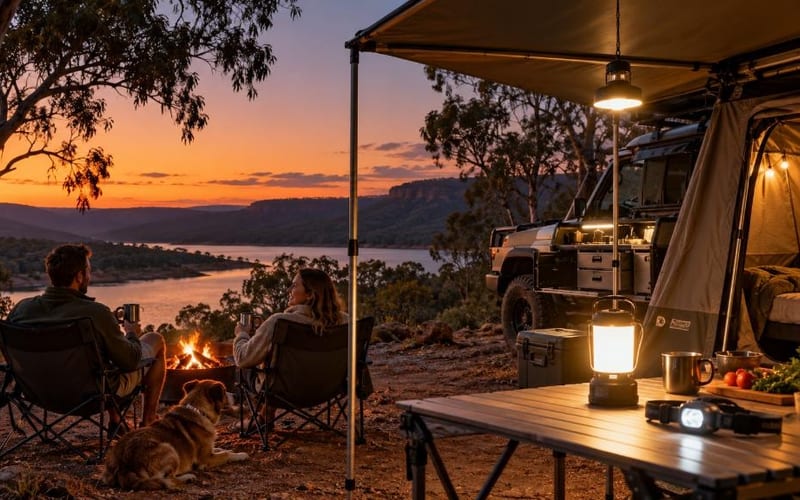
Rechargeable lanterns provide 360-degree illumination suitable for lighting a tent, camp kitchen or picnic table. Most offer multiple brightness settings, allowing you to balance light output against battery life. USB-C charging is now common on quality models. Look for models with a stable base that will not tip over easily on uneven ground. Some lanterns include a hook or loop for hanging from a tent ridgeline or awning rail.
Tent Lights and Magnetic Lights
Compact tent lights are designed to hang inside a tent or attach to a tent ceiling using a hook or magnetic base. Magnetic lights can attach to metal surfaces — vehicle bonnets, roof racks, camp kitchen frames — making them versatile for camp use. These lights are typically lower output than lanterns but are useful for reading, finding gear in a tent or providing ambient light in a small space.
Hanging Lights and String Lights
Hanging lights and LED string lights are popular for lighting awning areas and camp kitchens. They provide a wider spread of ambient light than a single lantern. USB-powered string lights can be run from a power bank or 12V USB adapter. Look for weather-resistant models if the lights will be exposed to rain or dew. String lights are generally not suitable as primary task lighting but are useful for ambient illumination of a larger area.
Headlamps
A headlamp provides hands-free lighting for tasks that require both hands — cooking, setting up camp, vehicle repairs or navigating at night. Most headlamps offer multiple brightness modes including a red light mode that preserves night vision and is less disruptive to others at a campsite. USB-C rechargeable headlamps are now widely available. Look for a comfortable headband, a tilt mechanism to direct the beam and a weight that is comfortable for extended wear.
Brightness Settings and Low-Power Modes
Multiple brightness settings allow you to match light output to the task. High brightness is useful for setting up camp or cooking; low brightness is adequate for reading or moving around a tent and extends battery life significantly. An emergency flashing mode is useful for signalling in an emergency. Manufacturer runtime figures are typically quoted at the lowest brightness setting — actual runtime at high brightness will be considerably shorter.
Runtime and Battery Life
Manufacturer runtime figures depend heavily on brightness setting and battery condition. A light quoted at 100 hours runtime will achieve that figure only at its lowest brightness setting. At maximum brightness, runtime may be 2–5 hours. Battery condition also affects runtime — older batteries or batteries that have been partially discharged hold less charge. For planning purposes, assume runtime at your typical brightness setting rather than the maximum quoted figure.
Water Resistance
Camping lights should be water resistant at minimum. Look for an IP rating — IP44 indicates splash resistance, IP65 indicates dust-tight and water jet resistance, IP67 indicates submersion resistance to 1 metre. For use in rain or near water, IP65 or higher is preferable. Headlamps used in wet conditions should be at least IPX4 (splash resistant from any direction).
Portability and Packability
Weight and packed size matter for hiking and backpacking. For car camping and caravanning, weight is less critical and a larger lantern with greater output and battery capacity is practical. For hiking, a compact rechargeable headlamp and a small collapsible lantern provide a good balance of weight and functionality. Collapsible lanterns that compress flat for packing are available and useful for reducing pack volume.
Caravan and 4WD Use
For caravanning and 4WD touring, 12V-compatible lights that can be powered directly from a vehicle or caravan battery system are available. USB-C rechargeable lights can be charged from a 12V USB adapter. Magnetic lights are particularly useful in a 4WD context, attaching to the vehicle body for hands-free lighting during vehicle maintenance or campsite setup. Consider whether lights will be used inside the caravan, under the awning or for external tasks when selecting brightness and beam type.
Emergency Backup Lighting
A reliable light source is an important part of an emergency kit. A headlamp with replaceable batteries provides a dependable backup that does not rely on charging infrastructure. Keep a spare set of batteries with the headlamp. A compact lantern provides better ambient light for a group in an emergency situation. Consider keeping a dedicated emergency light separate from your main camping lights so it is always available and fully charged or with fresh batteries.
Camping Light Types Compared
| Type | Best For | Power | Key Consideration |
|---|---|---|---|
| Rechargeable lantern | Camp kitchen, tent | USB-C | Needs charging access |
| Battery lantern | Remote trips | AA/AAA batteries | Carry spare batteries |
| Headlamp | Hands-free tasks | USB-C or AA | Comfort for extended wear |
| Magnetic light | Vehicle, camp kitchen | USB-C or AA | Versatile mounting |
| String lights | Awning, ambient | USB or 12V | Not for task lighting |
Affiliate Disclosure: Country Heart Outdoors participates in affiliate programs. If you purchase through our links, we may earn a commission at no extra cost to you. This helps support our free buying guides.