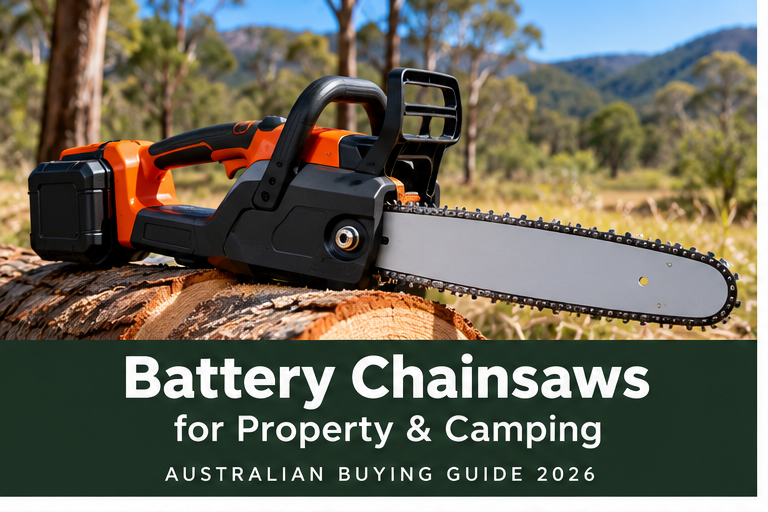
Battery Chainsaws for Property & Camping — Australian Buying Guide 2026
Battery-powered chainsaws have improved significantly over the past few years. Advances in lithium-ion battery technology have made cordless chainsaws a practical option for a wide range of tasks — from pruning fruit trees and clearing scrub to cutting firewood on a rural block or campsite. They are quieter than petrol models, require less maintenance, produce no exhaust fumes and can be charged from mains power, solar systems or portable power stations. For many property owners and campers, a battery chainsaw now handles the majority of cutting tasks without the complexity of a petrol engine. This guide covers the key factors to consider when choosing a battery chainsaw for Australian property and camping use. Always follow the manufacturer's instructions and obtain appropriate training before operating any chainsaw.
Affiliate disclosure: We may earn a commission if you purchase through our links, at no extra cost to you. Learn more.
Battery Voltage and Platform Compatibility
Battery chainsaws are available in a range of voltages — commonly 18V, 36V (sometimes marketed as 2x18V), 40V, 54V, 56V and 60V. Higher voltage generally means more power and better performance on larger timber, though actual cutting performance depends on the motor design, bar length and chain speed as well as voltage alone.
If you already own cordless tools from a particular brand, it is worth checking whether a chainsaw in the same voltage platform is available. Sharing batteries across tools reduces cost and simplifies charging. Major platforms include Makita 18V and 40V, DeWalt 18V and 54V, Milwaukee 18V and M18 FUEL, Ego 56V, Greenworks 40V and 60V, and Husqvarna 36V and 40V.
Bar Length
Bar length determines the maximum diameter of timber the saw can cut in a single pass. Common bar lengths for battery chainsaws range from 25cm to 45cm. A 30–35cm bar suits most pruning, limb removal and light firewood cutting. A 40–45cm bar handles larger logs and heavier property work. Longer bars require more power and reduce runtime per charge. For most camping and light property use, a 30–35cm bar is a practical starting point.
Chain Speed and Cutting Performance
Chain speed — measured in metres per second — affects how quickly and cleanly the saw cuts. Higher chain speeds generally produce cleaner cuts and reduce the effort required. Most battery chainsaws in the mid-to-upper voltage range deliver chain speeds comparable to entry-level petrol models. For light pruning and occasional firewood cutting, chain speed is rarely a limiting factor. For sustained heavy cutting, a higher-voltage model with a brushless motor will maintain performance better under load.
Runtime and Battery Capacity
Runtime per charge depends on battery capacity (measured in amp-hours, Ah), the voltage of the platform, the hardness of the timber and the intensity of use. A 5Ah battery in a 40V platform will typically cut more timber per charge than a 2Ah battery in the same platform. For extended sessions, having a spare battery or two is practical. Runtime figures quoted by manufacturers are often based on light cutting conditions — real-world runtime on hardwood firewood will be shorter.
Charging from Solar and Portable Power Stations
One advantage of battery chainsaws for off-grid and camping use is the ability to charge from a portable power station or solar system. Most battery chargers operate on 240V AC, so a portable power station with a suitable AC outlet can recharge batteries at a campsite or remote property. Charging time depends on battery capacity and charger output — a rapid charger will significantly reduce downtime between batteries. Check the charger's power draw against your power station's output rating before relying on this setup.
Weight and Portability
Battery chainsaws are generally lighter than equivalent petrol models, particularly when comparing smaller bar lengths. A compact 18V or 36V model with a 25–30cm bar may weigh 3–4kg with battery, making it easy to carry on a camping trip or store in a vehicle. Larger 56V or 60V models with longer bars can weigh 5–7kg with battery — still lighter than many petrol saws, but worth considering if portability is a priority.
Pruning vs Firewood Cutting
A compact battery chainsaw with a 25–30cm bar is well suited to pruning fruit trees, removing dead branches, clearing scrub and cutting smaller logs. For regular firewood cutting from larger rounds, a higher-voltage model with a 35–40cm bar and a high-capacity battery will be more productive. If you need to do both, a mid-range 40V or 56V model with a 35cm bar is a reasonable compromise.
Chain Maintenance and Tension
Regular chain maintenance is important for safe and efficient cutting. The chain should be kept sharp — a dull chain requires more force, produces more sawdust than chips and increases the risk of kickback. Most battery chainsaws include a tool-free chain tensioning system. Check chain tension before each use and adjust as required. The bar and chain should also be lubricated — most models have an automatic oiler, but check the oil reservoir regularly and top up with bar and chain oil as needed.
Replacement Chains and Spare Parts
Chains wear over time and will eventually need replacing. When purchasing a chainsaw, check that replacement chains are readily available in Australia. Note the chain pitch, gauge and drive link count — these are usually printed on the bar or listed in the manual. Keeping a spare chain on hand is practical for extended property work or remote use.
Storage
Store the chainsaw with the bar cover fitted to protect the chain and prevent accidental contact. Store batteries separately in a cool, dry location away from direct sunlight and extreme heat. Do not store batteries fully discharged for extended periods — most manufacturers recommend storing lithium-ion batteries at around 50% charge for long-term storage.
Protective Equipment and Safety
Chainsaw use requires appropriate personal protective equipment (PPE). At minimum, this includes chainsaw-rated protective trousers or chaps, safety boots with chainsaw protection, gloves, eye protection and hearing protection. A helmet with face shield is recommended. Battery chainsaws are quieter than petrol models, but hearing protection is still advisable during extended use.
Chainsaw operation carries serious risks. Always follow the manufacturer's instructions. Obtain appropriate training before operating a chainsaw — recognised chainsaw training courses are available in Australia. Do not attempt to fell trees without proper training and experience. Keep bystanders clear of the work area.
Battery Chainsaw Voltage Platforms Compared
| Voltage | Typical Bar Length | Best Suited To | Runtime |
|---|---|---|---|
| 18V | 25–30cm | Light pruning and trimming | Moderate |
| 36V / 2x18V | 30–35cm | Pruning and light firewood | Good |
| 40V | 30–40cm | General property and firewood | Good |
| 56V / 60V | 35–45cm | Heavier property work | Good with large battery |
Affiliate Disclosure: Country Heart Outdoors participates in affiliate programs. If you purchase through our links, we may earn a commission at no extra cost to you. This helps support our free buying guides.