12V & Induction Cooking for Camping — Australian Guide 2026
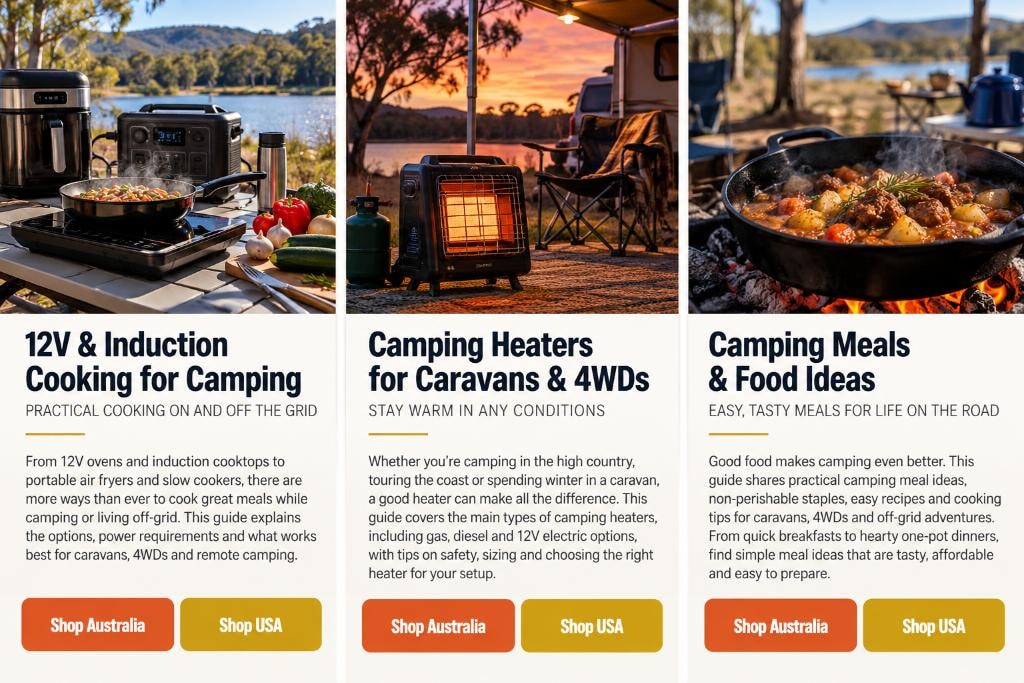
Cooking away from mains power has changed significantly over the last few years. Traditional LPG camp stoves are still common, but larger lithium battery systems, portable power stations and efficient inverters have made electric cooking increasingly practical for caravans, camper trailers and well-equipped 4WD touring setups. That does not mean every 12V system can run an induction cooktop, air fryer or electric cooker. These appliances can require substantial power, so the right solution depends on your battery capacity, inverter rating, charging system and how often you intend to cook electrically. This guide explains the main electric cooking options for Australian camping and off-grid travel, what sort of electrical system they require and where they make sense compared with traditional gas cooking.
Affiliate disclosure: We may earn a commission if you purchase through our links, at no extra cost to you. Learn more.
What Does 12V Cooking Actually Mean?
The term 12V cooking covers several different types of equipment. Some appliances operate directly from a 12V DC socket — these tend to be relatively low-powered products such as travel ovens, food warmers and small slow cookers. Other appliances — including most induction cooktops, air fryers, kettles and conventional electric cooking equipment — normally operate on 240V AC and are powered through an inverter connected to the vehicle, caravan battery bank or portable power station. The distinction matters because running a high-powered 240V appliance through an inverter can place a much larger load on the battery system than a small direct-12V appliance.
Direct 12V Cooking Appliances
Direct-12V appliances are attractive because they are simple and generally do not require a separate inverter. Common examples include portable 12V ovens, travel food warmers, small slow cookers, heated lunch boxes and compact cooking pots. Their biggest advantage is relatively modest power demand. Their limitation is usually cooking speed — a low-powered 12V oven may be excellent for slowly heating or cooking a meal while travelling, but it is not a direct replacement for a high-output gas burner or induction cooktop. Check the appliance current draw and confirm the outlet, wiring and fuse are suitable for that load before use.
Portable Induction Cooking
Induction cooking has become increasingly popular in caravans and larger off-grid systems. An induction cooktop heats compatible cookware using an electromagnetic field rather than heating a traditional hotplate. Advantages include rapid heating, good temperature control, no open flame, easy cleaning, less heat released into a caravan or cooking area and the ability to use stored solar energy instead of LPG. The main disadvantage is power consumption — a portable induction cooktop may draw considerably more power than most small 12V appliances and normally requires a suitable inverter or portable power station with adequate AC output. Before buying, check appliance wattage, inverter continuous rating, battery capacity, battery discharge capability, cable and fuse ratings, charging capacity and cookware compatibility.
Portable Air Fryers
Air fryers are another increasingly common caravan and camping appliance. They are convenient for vegetables, chicken, reheating meals, sausages, small roasts, chips and simple one-pot-style meals. The practical limitation is electrical demand — an air fryer may operate for only a relatively short time, but it can draw substantial power while running. For travellers with a large lithium bank, good solar input or a suitable portable power station, an air fryer can be practical. For small auxiliary battery systems, it may consume too much of the available energy budget.
Electric Kettles and Coffee Equipment
Heating water electrically requires significant energy because water has a high heat capacity. A high-powered kettle boils quickly but can place a substantial instantaneous load on the inverter and battery bank. Lower-powered travel kettles may reduce the peak load but take considerably longer. For coffee drinkers, alternatives include stovetop moka pots, manual pour-over coffee, French press and low-powered travel coffee makers. The best choice depends on whether convenience or minimum electrical consumption is the priority.
Using a Portable Power Station
A portable power station can simplify electric cooking because the inverter, battery, protection systems and outlets are contained in one unit. When comparing a power station for cooking, look at AC output rating, battery capacity in watt-hours, surge rating, charging speed, solar input capability, weight, battery chemistry and available AC outlets. Do not select a power station only by battery capacity — the inverter output must also be capable of operating the appliance.
Battery Capacity and Cooking Time
Electric cooking should be considered as part of your total daily power budget. Your battery also needs to supply other loads such as your 12V fridge, lights, water pump, phone charging, laptops, Starlink, fans, television and any medical or communications equipment. A cooking appliance may only run for 10–30 minutes, but high-power loads can still consume a meaningful amount of stored energy. Always allow a reserve rather than planning to discharge the system completely.
Gas vs Electric Cooking
Neither system is automatically better. Gas can be better when battery capacity is limited, when travelling in cloudy weather, when cooking for large groups or when touring remotely with limited electrical charging. Electric can be better when you already have a substantial lithium system, when solar capacity is strong, when you want to reduce LPG use or when you want precise temperature control. Many travellers use both systems — that provides flexibility if batteries are low, LPG is unavailable or weather reduces solar generation.
Electrical Safety
High-powered electric cooking appliances should only be used with equipment designed for the load. Do not use undersized extension leads, wiring, sockets or improvised electrical connections. Permanent 240V electrical work in caravans and recreational vehicles should be carried out by appropriately licensed persons in accordance with applicable requirements. Follow the appliance, inverter, battery and vehicle manufacturer's instructions.
Electric Cooking Options Compared
| Cooking Method | Main Advantage | Main Limitation | Best Suited To |
|---|---|---|---|
| 12V travel oven | Simple, low-power cooking | Slow | Touring and reheating |
| Induction cooktop | Fast and controllable | High electrical demand | Larger battery systems |
| Air fryer | Convenient and versatile | High electrical demand | Caravans and power stations |
| Electric kettle | Fast hot water | High short-term load | Larger inverter systems |
| Gas stove | Simple and proven | Requires fuel and open flame | Most camping setups |
| Dual setup | Maximum flexibility | More equipment to carry | Extended touring |
Affiliate Disclosure: Country Heart Outdoors participates in affiliate programs. If you purchase through our links, we may earn a commission at no extra cost to you. This helps support our free buying guides.