12V Fridge Power Consumption: What You Need to Know
One of the most common questions from new campers and caravanners is: how long will my battery run my 12V fridge? The answer depends on several factors — fridge size, ambient temperature, thermostat setting, how often you open the lid, and what type of battery you're running. This guide breaks it all down in plain Australian terms so you can size your system with confidence.
Affiliate disclosure: We may earn a commission if you purchase through our links, at no extra cost to you. Learn more.
How Much Power Does a 12V Fridge Use?
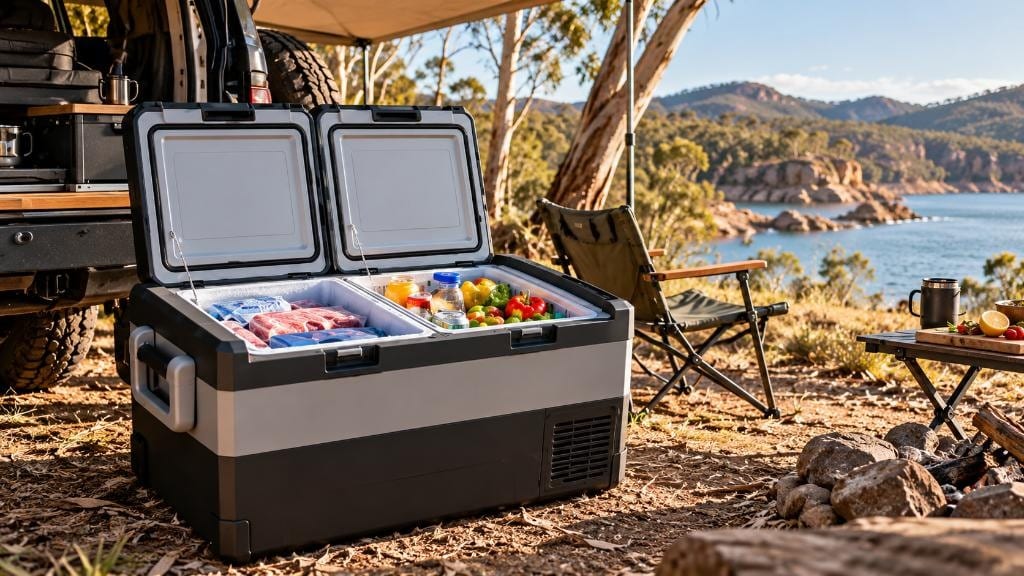
A 12V compressor fridge doesn't draw power continuously — the compressor cycles on and off to maintain the set temperature. The figure that matters is average current draw, measured in amps (A) or watts (W). A typical quality 40–50L 12V fridge draws between 0.8A and 1.5A average in moderate conditions (around 25°C ambient). In hot Australian summer conditions (35–40°C), expect average draw to climb to 2–3A. Smaller fridges (25–35L) generally draw 0.5–1A average; larger units (60–80L) typically draw 1.5–2.5A in moderate conditions. Note: actual consumption varies significantly by fridge model, insulation quality, compressor efficiency and operating conditions.
Running Watts vs Daily Energy Use
Running watts tells you how much power the compressor draws when it is actively running — typically 40–80W for most 12V camping fridges. But because the compressor only runs part of the time (the duty cycle), the more useful figure is daily energy use in amp-hours (Ah) or watt-hours (Wh). For example, a fridge drawing 45W when running, with a 50% duty cycle, uses roughly 22.5W on average — or about 540Wh (45Ah at 12V) per day. In cooler conditions the duty cycle drops and daily consumption falls; in hot conditions the compressor runs more often and consumption rises. Always check the manufacturer's published average draw figures, and treat them as a guide rather than a guarantee.
What Affects Power Consumption?
Four main factors drive how much power your 12V fridge uses day to day. Fridge size: larger fridges have more air volume to cool and generally draw more power, though a well-insulated large fridge can outperform a poorly insulated small one. Ambient temperature: as ambient temperature rises, the compressor normally runs for longer periods and daily power consumption can increase substantially. The exact increase varies by fridge design, insulation, ventilation and thermostat setting. Thermostat setting: setting your fridge to 2°C instead of 5°C forces the compressor to work harder; for most food storage, 3–5°C is ideal. Lid opening frequency: every time you open the lid, warm air rushes in and the compressor has to work to cool it back down. Minimise lid openings, especially in hot weather, and consider a fridge with a separate freezer compartment so you're not letting cold air out every time you grab a drink.
Typical Consumption Examples
Here are realistic average draw figures for three common fridge sizes under Australian conditions. Small fridge (25–35L): approximately 0.5–1.0A average in mild conditions (20–25°C), rising to 1.5–2.0A in hot conditions (35–40°C). Medium fridge (40–55L): approximately 0.8–1.5A average in mild conditions, rising to 2.0–3.0A in hot conditions. Large fridge (60–80L): approximately 1.2–2.0A average in mild conditions, rising to 2.5–4.0A in hot conditions. These are indicative figures only — actual consumption varies by fridge model and real-world conditions. Always check the manufacturer's data sheet for your specific model.
How Long Will a 100Ah Battery Run a 12V Fridge?
To estimate run time, divide usable battery capacity by average fridge draw. A 100Ah battery does not give you 100Ah of usable energy — the usable amount depends on battery type. For AGM or lead-acid batteries, many off-grid systems are designed around using about 50% of the rated capacity — deeper discharge is possible, but repeated deep discharge can shorten battery life, giving a practical planning figure of around 50Ah from a 100Ah AGM. For lithium (LiFePO4) batteries, usable capacity depends on the manufacturer's specifications and BMS settings; 80–90% is a common planning range, giving roughly 80–90Ah from a 100Ah lithium battery, though always check your specific battery's documentation. These estimates assume no charging input — see the Example Battery Runtime table below.
AGM vs Lithium: Usable Capacity
The battery type you choose has a major impact on how long your fridge runs. AGM and flooded lead-acid batteries are the traditional choice — they are affordable and widely available. For good cycle life, many off-grid systems are designed around using about 50% of the rated capacity of an AGM or flooded lead-acid battery. Deeper discharge is possible, but repeated deep discharge can shorten battery life. A 100Ah AGM battery is commonly planned around 50Ah of usable energy. Lithium iron phosphate (LiFePO4) batteries are more expensive upfront but offer a much longer cycle life (typically 2,000–4,000 cycles versus 300–500 for AGM), lighter weight, and stable voltage throughout the discharge cycle. Usable capacity depends on the battery manufacturer's specifications and BMS settings — 80–90% is a typical planning range, giving roughly 80–90Ah from a 100Ah lithium battery, but always check your specific battery's documentation. This can be nearly double the effective capacity of an equivalent AGM. For serious campers running a fridge full-time, lithium is almost always the better long-term investment.
How Solar Panels Extend Fridge Run Time
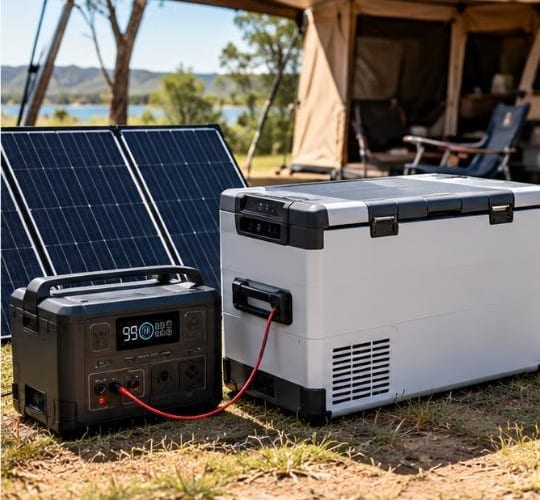
A solar panel connected to your battery system replenishes the energy your fridge draws during the day. The key is matching your solar input to your fridge's daily consumption. If your fridge uses 40Ah per day and your solar system produces 50Ah per day on average in good conditions, your battery stays topped up. Solar output varies with panel orientation, shading, cloud cover and the time of year — a 200W panel in full Australian summer sun might produce 60–80Ah per day, while the same panel in winter or under partial shade might produce 30–40Ah. A solar charge controller (MPPT type for best efficiency) is essential to regulate charging and protect your battery.
A Simple Example: 100Ah Battery + 200W Solar Panel
Let's say you have a 100Ah lithium battery (80Ah usable) and a 200W solar panel. Your medium 12V fridge draws 1.2A average (28.8Ah per day). Your 200W panel in good Australian conditions produces approximately 60Ah per day. Daily balance: 60Ah in minus 28.8Ah out = +31.2Ah surplus. In good solar conditions this system could replace more energy during the day than the fridge consumes. Poor weather, shading, winter conditions and other electrical loads can reduce or eliminate that surplus, so adequate battery reserve is still important.
Tips to Reduce Fridge Power Consumption
A few simple habits can meaningfully reduce how much power your 12V fridge draws. Pre-cool your fridge before loading it — running it empty for an hour before a trip means the compressor isn't working hard to cool warm food and drinks. Pre-chill food and drinks in a household fridge before loading them. Keep the fridge out of direct sunlight and away from heat sources — ambient temperature is the biggest driver of power consumption. Use a shade cover or insulating blanket on the fridge when parked in the sun. Set the thermostat to 3–5°C rather than the coldest setting — colder than necessary wastes power. Minimise lid openings, especially in hot weather. Keep the fridge well stocked — a full fridge holds temperature better than a half-empty one. Clean the condenser coils periodically if accessible, as dust buildup reduces efficiency.
12V Fridge Power Consumption by Size
| Fridge Size | Mild Conditions (20–25°C) | Hot Conditions (35–40°C) | Daily Use (Mild) | Daily Use (Hot) |
|---|---|---|---|---|
| Small (25–35L) | 0.5–1.0A avg | 1.5–2.0A avg | 12–24Ah | 36–48Ah |
| Medium (40–55L) | 0.8–1.5A avg | 2.0–3.0A avg | 19–36Ah | 48–72Ah |
| Large (60–80L) | 1.2–2.0A avg | 2.5–4.0A avg | 29–48Ah | 60–96Ah |
Example Battery Runtime
Estimates only — assumes no charging input (no solar, no alternator). Actual run time will vary with fridge model, ambient temperature and real-world conditions.
| Battery | Usable Capacity | Fridge Avg Draw | Estimated Runtime |
|---|---|---|---|
| 100Ah AGM | 50Ah | 1.2A avg | ~42 hours |
| 100Ah Lithium | 80Ah | 1.2A avg | ~67 hours |
| 100Ah AGM | 50Ah | 2.5A avg (hot conditions) | ~20 hours |
| 100Ah Lithium | 80Ah | 2.5A avg (hot conditions) | ~32 hours |
Affiliate Disclosure: Country Heart Outdoors participates in affiliate programs. If you purchase through our links, we may earn a commission at no extra cost to you. This helps support our free buying guides.